2026 Honda Prelude Review: Is Slower More Fun?

Our 2026 Honda Prelude review examines its simulated shifts, Type R hardware, 44-mpg rating, useful hatch and difficult $43,195 price.
Here is the wonderfully peculiar thing about the new Prelude: press the button intended to make the car feel more exciting, and it may take longer to reach 60 mph.
That fact will keep internet comment sections fed for months, but it also gets to the heart of Honda’s new hybrid coupe. The Prelude is not an attempt to win the acceleration Olympics. It is an attempt to make an efficient everyday car feel interesting at legal speeds, and Honda is willing to sacrifice a measurable amount of performance to accomplish it.
The returning coupe uses a 200-horsepower two-motor hybrid system and carries an EPA rating of 46 mpg city, 41 mpg highway and 44 mpg combined. The original 2026 model started at $42,000 plus a $1,195 destination charge, making the delivered starting figure $43,195.
That is serious money for a front-wheel-drive Honda with no conventional gearbox. It is also why the Prelude deserves to be judged on more than nostalgia and an entertaining button.
You may also like this video:
Why the 2026 Honda Prelude Review Starts With S+
S+ Shift is the Prelude’s party trick. Honda’s hybrid system has no conventional eight-speed automatic, but the software creates eight virtual ratios. Select Sport mode, activate S+, and the car changes its engine behavior, instrument display and interior sound to imitate a performance transmission.
The paddles produce simulated upshifts and downshifts. Brake for a bend and the system can create a rev-matched downshift. Accelerate through the corner and it can hold a virtual gear to preserve the relationship among sound, engine speed and driver input.
According to Honda’s official 2026 Prelude press kit, the control strategy coordinates the gasoline engine and electric drive motor to reproduce shift responses, gear holding and throttle blips. These are generated behaviors, not physical gear changes.
Then comes the number that makes the entire idea fascinating. Car and Driver’s instrumented test recorded 60 mph in 6.5 seconds with S+ off and 7.3 seconds with it operating. The interruption that helps sell each virtual shift also delays acceleration.
That does not mean the normal setting is secretly the sportier one. It means Honda is defining entertainment separately from maximum speed. S+ gives the driver more events to experience—rising revs, paddle inputs, downshift sounds and pauses—even though the stopwatch prefers the uninterrupted delivery of the standard hybrid programming.
There is a sensible way to use both. Keep S+ disengaged when joining a short freeway ramp or attempting the quickest possible pass. Switch it on when the road is interesting and the extra interaction matters more than eight-tenths of a second.
You may also enjoy: 2026 Honda Prelude Hybrid: Type R Parts, Real GT

The Useful Parts Did Not Come From a Sound Studio
It would be easy to dismiss the Prelude as a Civic Hybrid wearing formal clothes and making theatrical noises. The chassis prevents that criticism from being entirely fair.
Honda borrowed the dual-axis strut front-suspension design, dual-pinion variable-ratio steering and four-piston Brembo front calipers from the Civic Type R engineering cupboard. The Prelude also has adaptive dampers tuned specifically for its weight, tires and grand-touring purpose.
The important word is “borrowed.” This is not a Type R underneath. The Prelude has 200 horsepower and 232 pound-feet of torque, while the Type R has much greater output, a six-speed manual transmission and a considerably more aggressive mission. The connection concerns selected hardware and engineering ideas rather than equivalent performance.
The components still matter. A dual-axis front-strut arrangement helps manage steering behavior in a powerful front-wheel-drive car. Adaptive dampers allow Honda to provide firmer body control when requested without condemning owners to a punishing ride every morning.
Car and Driver recorded 0.93 g on the skidpad and a 154-foot stop from 70 mph. Those results are more persuasive evidence of the Prelude’s engineering priorities than its acceleration time. The car can generate meaningful grip and braking performance while returning an EPA-rated 44 mpg combined.
Honda supplies Comfort, GT, Sport and Individual drive modes. Individual is the one I would investigate first because it allows a driver to assemble a preferred combination instead of accepting every characteristic bundled into a preset. A tauter chassis response does not always require the most aggressive sound or accelerator programming.
For government context on how the mileage figure is produced and why an owner’s result may differ, FuelEconomy.gov explains EPA estimates, comparison tools and the variables that affect real-world consumption.
You may also enjoy: How IndyCar Hybrid Tech Boosts Your Next Honda Hybrid

What $43,195 Buys—and What It Does Not
The Prelude’s price is its hardest problem. The $42,000 MSRP becomes $43,195 after destination, before paint, accessories, taxes or dealer charges. At that level, buyers are entitled to ask why they should not simply purchase a Civic Hybrid and keep the difference.
The Civic Sport Touring Hybrid provides related 200-horsepower propulsion, four proper doors and stronger family usefulness for substantially less. The Prelude answers with a more distinctive body, lower seating position, specialized suspension, larger front brakes, adaptive dampers and a rarer ownership experience.
A Toyota GR86 or Mazda MX-5 Miata offers a more orthodox enthusiast formula. Both are available with manual transmissions and send power to the rear wheels. The Miata is a focused two-seater with limited cargo capacity; the GR86 includes token rear accommodations but remains far less efficient than the Prelude.
The Civic Type R is the choice for a driver who needs speed, track credibility, a manual gearbox and usable rear doors. It also costs more and asks its owner to accept a more intense personality. The Prelude is the softer and thriftier option, not a substitute Type R.
That narrows the buyer profile. The Prelude makes the most sense for someone who commutes regularly, wants one car rather than a dedicated weekend toy, prefers coupe styling and still cares about steering, braking and body control. It makes less sense for an acceleration-first buyer or anyone who needs adult-friendly rear access every day.
Shoppers should also avoid treating projected fuel savings as automatic justification for the premium. Compare the Prelude with the vehicle you would realistically buy instead, use your annual mileage and local fuel price, and calculate the complete ownership difference. The federal fuel-cost calculator provides a more useful starting point than an optimistic dealership estimate.
You may also enjoy: 2025 Honda Civic Hybrid Returns With Style
A Coupe With a Hatch—and a Dog Limitation
The Prelude’s most valuable everyday feature may be behind the rear glass. Instead of the small trunk opening associated with older Preludes, the complete rear hatch lifts to expose 15.1 cubic feet of cargo room with the seatbacks upright.
The 60/40-split rear seats fold for longer cargo, making the car useful for luggage, shopping or equipment that would be awkward to load into a traditional coupe. This practical opening materially improves the Prelude’s prospects as an only car.
It can also accommodate a smaller dog, provided the animal is properly restrained and the cargo temperature is managed. The qualification matters: the roof falls rapidly toward the rear, reducing vertical space. A larger Labrador will be happier secured across the folded rear-seat area or riding on the back seat with an appropriate harness than standing beneath the lowest portion of the hatch.
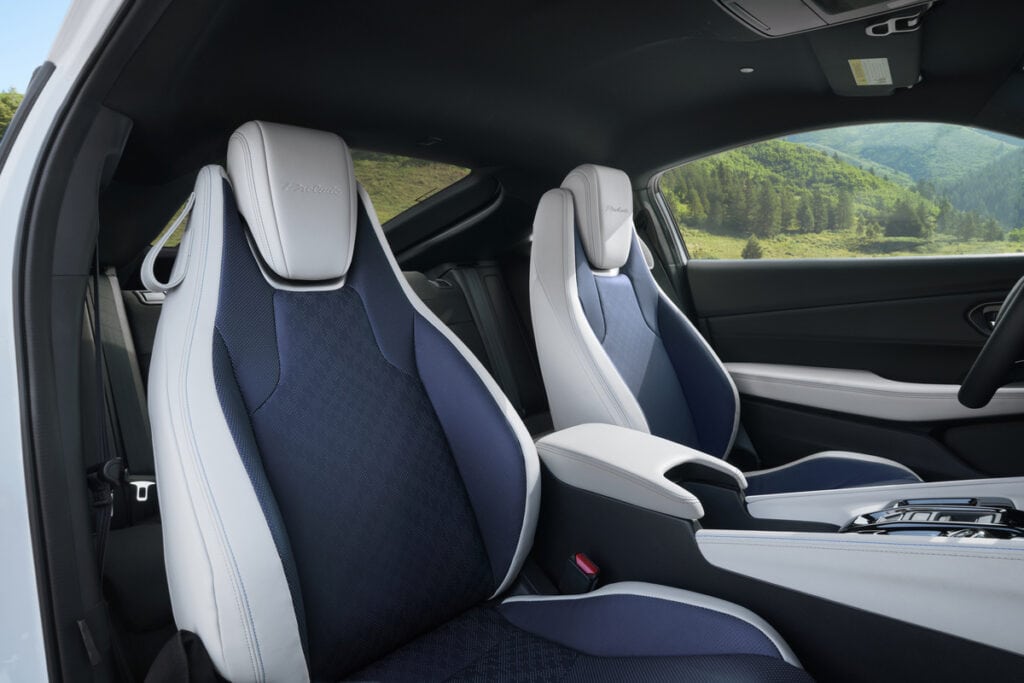
The second row is better understood as contingency space. Honda lists four seats and 32 inches of rear legroom, but two doors and a low roof make access difficult. Children, small adults on short journeys, coats and camera bags are more realistic occupants than four adults beginning a long road trip.
Front-seat life is easier. The Prelude includes a 9-inch touchscreen, a 10.2-inch digital instrument cluster, Google built-in, wireless Apple CarPlay and Android Auto, wireless phone charging and USB-C connectivity. Physical climate switches and knobs remain available, allowing common adjustments without navigating an on-screen menu.
That restraint deserves recognition. Touchscreens are useful for maps, audio libraries and settings with many possible choices. Temperature and fan speed are repetitive controls that should remain easy to locate by feel. Honda has correctly separated the two jobs.
You may also enjoy: Deals Didn’t Disappear. They Just Got Weird. Here’s the Fix.

Safety Technology Helps, but the Driver Remains Responsible
The Prelude includes the Honda Sensing collection of driver-assistance features. Collision Mitigation Braking can respond to a potential frontal crash, while adaptive cruise control manages a selected following interval. Lane Keeping Assist and Road Departure Mitigation provide additional steering or warning support.
Blind-spot information, rear cross-traffic monitoring and parking sensors address situations made more difficult by a low coupe body and sloping rear profile. These features are useful, but their names can make them sound more capable than they are.
The National Highway Traffic Safety Administration’s driver-assistance guide explains that automatic emergency braking, adaptive cruise control and lane support remain assistive technologies. The person behind the wheel retains responsibility for steering, braking, observation and safe operation.
There is evidence that some of these systems reduce crashes. The Insurance Institute for Highway Safety reports that blind-spot detection has been associated with a reduction in lane-change crashes. However, a feature’s presence on a specification sheet does not establish how well a particular model performs in independent testing.
Shoppers should check current crash-test results when they become available rather than assuming that shared brand technology guarantees an identical outcome. The IIHS vehicle-shopping safety guide explains how to compare crashworthiness, headlights, front-crash prevention and child-restraint access.
You may also enjoy: Honda’s Next Move: Hybrids, EVs, and Supply

Who Should Buy the 2026 Honda Prelude?
Buy the Prelude if you want an efficient personal coupe that remains comfortable enough for routine use, has a genuinely useful hatch and treats handling as more important than a heroic horsepower number. The combination is uncommon now that two-door cars have become rare and most new hybrids prioritize family transportation.
Skip it if you need regular access to the second row, want rear-wheel drive, insist on a manual transmission or judge performance primarily by acceleration. A Civic Hybrid, GR86, Miata or Civic Type R will answer one of those priorities more directly.
The Prelude’s candid weakness is value. Honda asks buyers to pay for specialized chassis components, styling and character rather than additional power. Some shoppers will reasonably conclude that $43,195 is too much for 200 horsepower and simulated gear changes.
Others will recognize that horsepower is only one ingredient. A car used every day must also ride properly, stop securely, fit luggage, manage traffic and avoid turning every fuel stop into financial theater. On those terms, 44 mpg combined and a liftback body carry real weight.
Honda’s broader hybrid strategy also provides context. The company is treating gasoline-electric propulsion as a mainstream answer rather than an apologetic halfway measure. Test Miles has examined how Honda’s hybrid strength supports its changing EV strategy, and the Prelude is the emotional end of that plan: proof that the same basic efficiency concept can serve something less sensible than a family crossover.
S+ Shift encapsulates the wager. It cannot transform the Prelude into a manual Type R, and anyone expecting that result will be disappointed. What it can do is add rhythm and response to a hybrid system that would otherwise deliver its performance with clinical smoothness.
The stopwatch says the Prelude is better with S+ switched off. The driver may reach a different conclusion. That disagreement is not a defect in the concept; it is the reason the car is interesting.
The new Prelude is built for someone who wants to enjoy the journey without paying for that enjoyment at every gas station. Even when the most entertaining setting makes the journey fractionally longer.