Race Car Tech Hiding in Your Daily Driver
By Robert R Guio
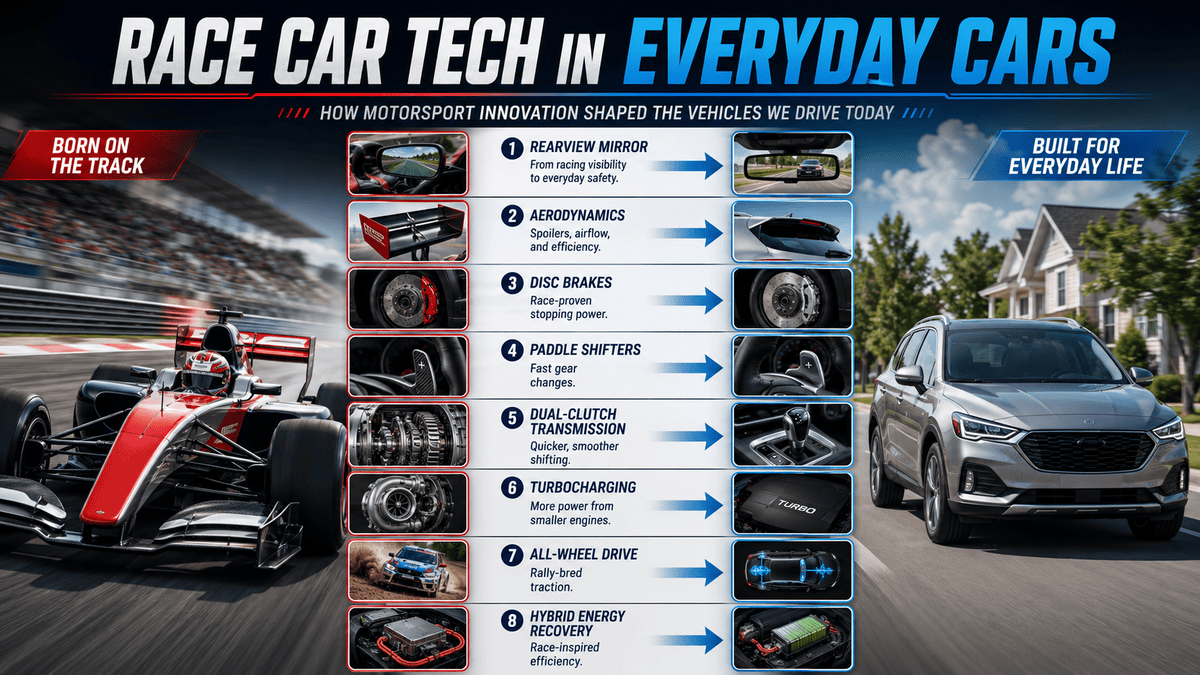
The next time someone says racing has nothing to do with real cars, point at the mirror, the brakes, transmission, and all-wheel drive. Motorsport is a strange laboratory. It’s loud, expensive, emotional, and occasionally absurd, but it forces engineers to solve problems quickly, under pressure, in public.
The trick is separating true race-born technology from ideas that racing helped polish. Not every feature in your crossover was invented at Indianapolis, Le Mans, or a rally stage. Some were developed elsewhere, then racing made them stronger, faster, lighter, or more reliable. Either way, the road car usually wins.
That’s why this story matters. Racing helps explain why a modern family SUV can stop hard in the rain, shift gears instantly, manage traction on snow, recover energy while braking, and slip through air better than many sports cars from a generation ago.
You may also like: How IndyCar Hybrid Tech Boosts Your Next Honda Hybrid
The Mirror, The Air, And The First Lesson
The most charming example is still the rearview mirror. Ray Harroun used one on the Marmon Wasp when he won the first Indianapolis 500 in 1911. Instead of carrying a riding mechanic to watch traffic behind him, Harroun used a simple visual solution. Today, that idea has evolved into mirrors, cameras, blind-spot warnings, and digital rearview displays.

Aerodynamics followed a similar path. Early racers learned that air was something to manage. Streamlined bodies, spoilers, diffusers, active shutters, air curtains, and flat underbody panels all owe something to racing’s obsession with stability and speed. Now the payoff is quieter cabins, better fuel economy, more EV range, and fewer stops.
You may also like: Genesis GT3 Concept Puts Luxury on the Grid
Racing Made Cars Stop Better
Racing also changed how cars stop. Jaguar and Dunlop helped prove disc brakes in endurance competition when the C-Type won at Reims in 1952 with discs, a major step beyond traditional drums. Faster cars created more heat, and heat made drum brakes fade. Disc brakes handled that punishment better.

Today, even ordinary vehicles benefit from that lesson. Vented rotors, better pads, brake cooling, anti-lock braking, stability control, and modern tire compounds all reflect the same basic truth: speed is only useful if the car can control it. Racing gave engineers a brutal test environment where weakness had nowhere to hide.
Tires learned the same lesson. Wet-weather racing, endurance racing, and rallying pushed tire makers to think harder about grip, heat, wear, and water evacuation. Your family crossover is not a race car, thankfully, but its tires are smarter because motorsport kept asking difficult questions.
You may also like: Audi Nuvolari Makes The R8 Look Sensible
Shifting Faster Became Normal
Gearboxes are one of the clearest racing-to-road stories. Ferrari’s Formula 1 semi-automatic gearbox helped make paddle shifting glamorous, then road cars made it convenient. What once looked exotic in a Ferrari is now available in sedans, SUVs, hot hatches, and even some trucks.

Porsche’s PDK dual-clutch transmission followed the same path. Porsche developed and tested the dual-clutch idea in racing, including the 956 and 962 programs, before it eventually reached production cars. One clutch handles one gear set, the second prepares the next, and the shift happens with barely any interruption.

Turbocharging gained much of its modern credibility through racing. Turbos existed long before they became common in commuter vehicles, but racing helped prove how smaller engines could produce serious power. Today, that idea shows up in compact crossovers, pickups, luxury cars, and hybrids.
You may also like: Jaguar Type 00: Smooth, Linear, Powerful, Return to Soul
Rally Roads And Hybrid Futures
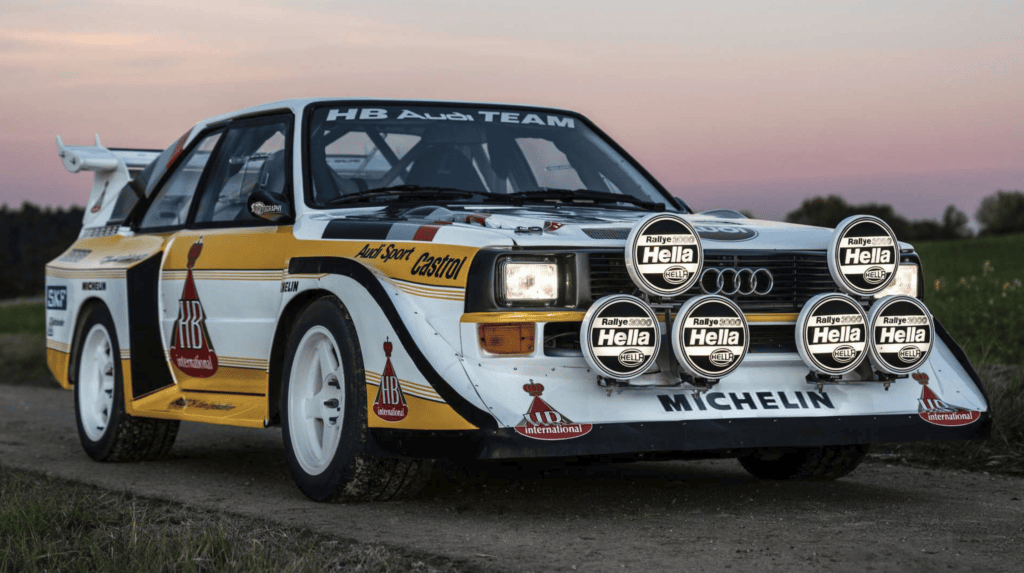
All-wheel drive may be the best example of racing making a technology mainstream. Audi’s quattro rally success in the 1980s changed the public understanding of four driven wheels. It was not just for trucks or snow anymore. It could make a car faster, more controlled, and more confidence-inspiring.
Hybrid systems are the newest chapter. IndyCar, Formula 1, endurance racing, and Formula E all use racing to study energy recovery, battery control, cooling, software, and power delivery. In a normal car, the results are less dramatic but more useful: better efficiency, sharper response, and smarter energy management.
That is the quiet beauty of racing technology. The race car gets the noise and glory. The production car gets the lessons. Your driveway may never look like Le Mans, Indianapolis, or Monte Carlo, but a surprising amount of those places is already parked in it.