Mercedes-Benz Takes On Tesla FSD With New Hands-Free Tech
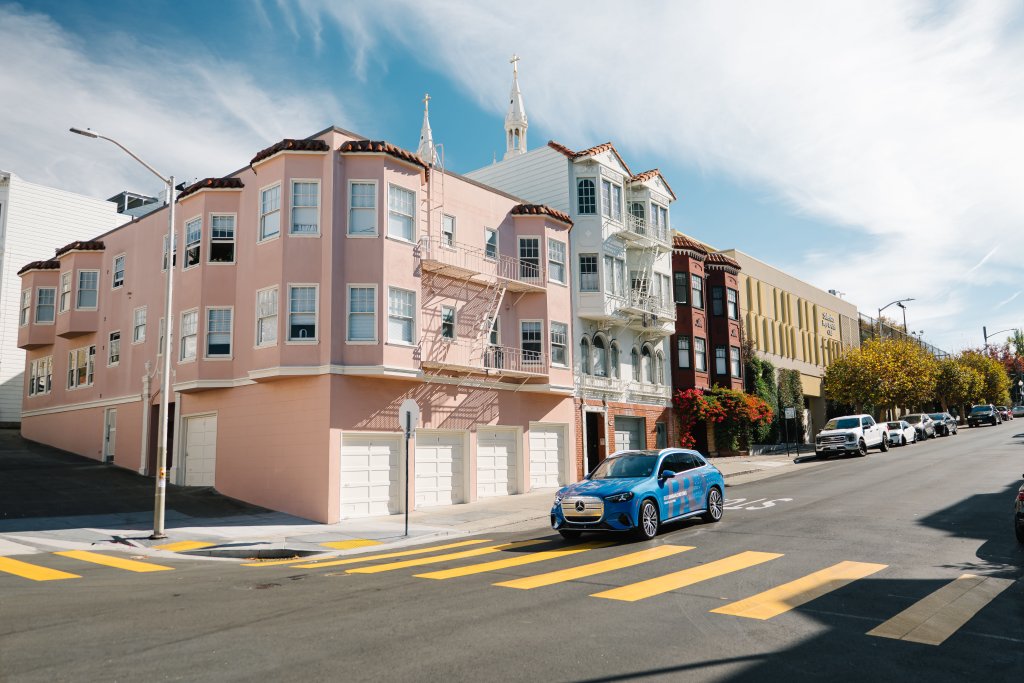
We test Mercedes-Benz hands-free highway driving and urban driving assistance in San Francisco. Here’s how the tech works and when it arrives.
By Sam Abuelsamid for Test Miles
A year ago when Mercedes-Benz was launching the latest generation CLA, the automaker showed off some new driver assist technologies enabled by its use of the full Nvidia Hyperion Drive hardware and software platform. But much of the most interesting technology wasn’t yet ready for full release to customers.
Mercedes and Nvidia have continued development and testing of both hands-free highway driving and point-to-point urban driving and are nearly ready to release those features so last week they brought us to San Francisco to try out those and other new features.
You may also like this video:
What is Hyperion Drive?
Back in the mid-2000s when teams were developing the first generation of modern automated vehicles (AVs) for the DARPA Grand Challenge, many of the vehicles were filled with server racks packed with Intel CPUs and Nvidia GPUs. By 2015, Nvidia saw the growth potential for AVs and started building development kits based on its latest generation chips and selling them as the Drive PX development platform.
Over time, this platform was continuously upgraded with newer generations of compute hardware and Nvidia defined a reference set of sensors which was rebranded as Hyperion Drive. Nvidia also started developing its own software platform that it made available for the companies buying its chips.
Today, many automakers use Nvidia Orin system-on-chip including Volvo, Polestar, Rivian, Lucid and numerous Chinese automakers, but they’ve all built their own software.
MB.OS
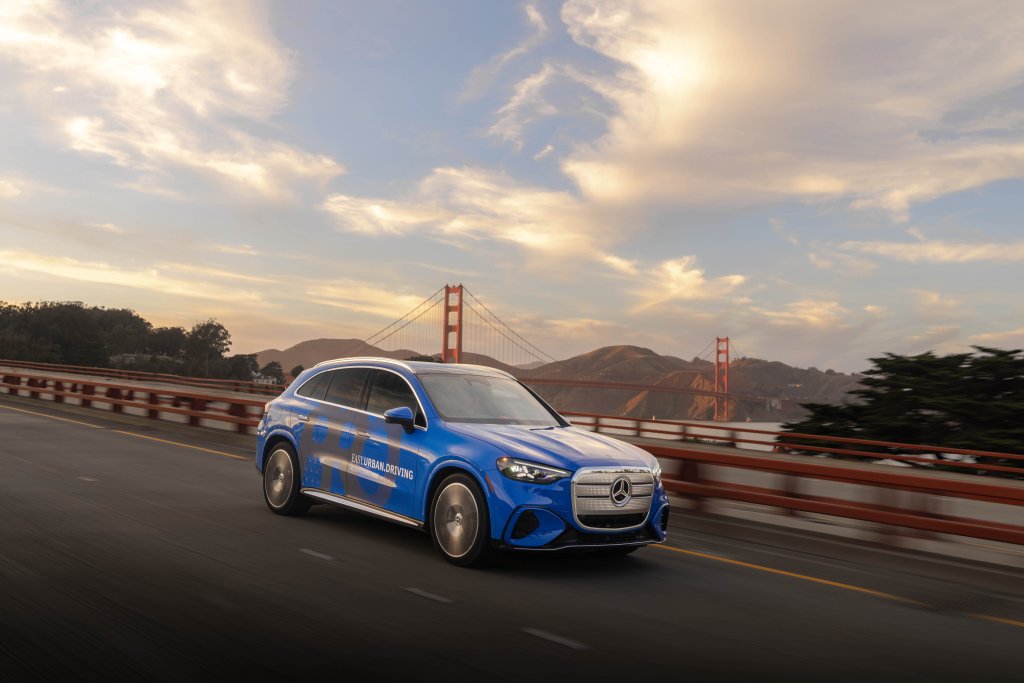
Mercedes is the first automaker to use the full Hyperion Drive software stack along with the hardware which is built into what it calls MB.OS. MB.OS is the full electronic/electrical architecture which is now used in the latest CLA, GLB, GLS, GLS, C-Class and S-Class with more to come.
In addition to the driving assist powered by Nvidia, MB.OS includes Qualcomm Snapdragon Cockpit chips to power the infotainment and communications plus NXP and Infineon chips for body control and other functions.
All of the MB.OS-equipped vehicles come equipped with 10 cameras (front wide-angle and telephoto, 4 surround and 4 side view), 5 radars (front medium range and 4 short range corner sensors) and 12 ultrasonic sensors. Through OTA updates, all of these machines will be able to support the features we tried and more.
However, Mercedes has confirmed that they will be bringing back a new version of the hands-off/eyes-off Drive Pilot system that supports speeds up to 80 mph, lane changes and operation in bad weather but it will require a new generation of MB.OS.
Going Hands-Off
By now, you’ve probably heard about the SAE standard for classifying assisted and automated driving. Level 0 is like my 1990 Mazda Miata which has no assistive systems at all, I’m responsible for shifting, steering, accelerating and even putting the key in the lock.
Level 5 is a vehicle capable of driving itself to a destination without human supervision on any road at any time in any weather. It should be noted that none of the definitions say anything about whether there is a steering wheel or pedals in the car. An L5 capable vehicle can still have human controls and the ability to be driven manually.
The problem with these level definitions comes in the messy middle around L2 and L3. L2 says the vehicle can manage steering and speed under a single system but with continuous human supervision. Again, no mention of the steering wheel or where the driver’s hands are.
Thus we have a broad range of vehicles that are classified as L2 with an equally diverse range of capabilities so the industry has sort of come up with its own definitions. Plain old L2 is now typically used for hands-on systems that combine adaptive cruise control and lane centering like the base version of MB.Drive which launched on the CLA last year.
L2+ is generally used for a hands-off/eyes-on system that can follow the lane and maintain a safe distance to the vehicle ahead while operating on a defined set of roads. The first system of this type was GM’s Super Cruise that debuted in 2017 and is now offered on more than 20 models and Mercedes calls theirs MB.Drive Assist.
L2+ systems don’t respond to traffic signals and signs but L2++ systems can follow a navigation path, making turns, stopping at signals and taking you to a destination while you watch the road and continue to be ready to resume full control which Mercedes calls MB.Drive Assist Pro.
We sampled MB.Drive Assist in two scenarios, heading south from Alameda on the I-880 and then crossing the Bay Bridge from San Francisco to Oakland and back. For the most part, it works very much like what we’ve become used to from Super Cruise and other systems. I did the Alameda run in a GLE 450 and then crossed the bridge in an S580e.
The Nvidia software kept both vehicles planted solidly in the middle of the lane with no wandering except when passing a large truck or bus. Then, like some other systems it would nudge over to the opposite side of the lane while not crossing out in order to provide a bit of extra clearance.
Both the Assist and Pro functions are designed to be collaborative with the driver. If you want a bit more room, just steer where you want to go and then when you release the wheel, it will continue without disengaging the system.
If you’re using navigation, at about 1.5 to 2 miles before an exit, the system will automatically change lanes over to the right (or left depending on where the off-ramp is) to prepare to get off the highway.
One really nice feature I noticed on I-880 was how the system handled the start of the express lane. In the vehicle settings you can define how many occupants are in the car and mine was set to one.
As we approached the beginning of the express lane, the car signaled a lane change, but then when it recognized the express lane sign, it canceled and didn’t move over. If there had been two or more occupants it would have gone into that lane. MB.Drive Assist hands-free operation will initially be available on limited access, divided highways of which there are approximately 130,000 miles in the US.
Going Pro
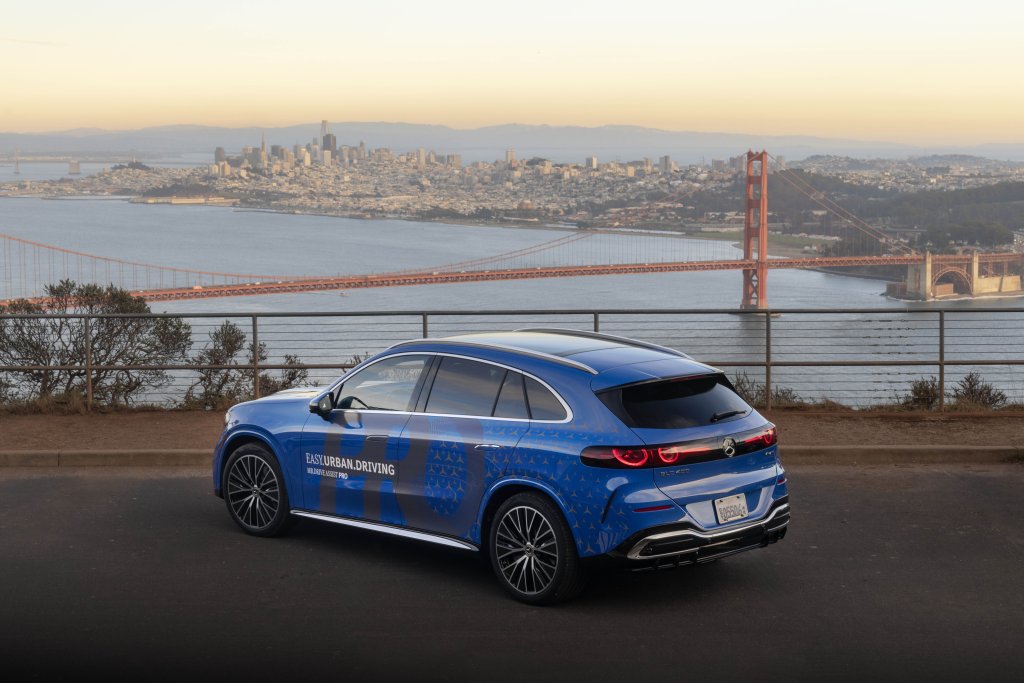
The Pro system is designed to provide full point-to-point urban driving capability, following the navigation route and obeying all traffic rules. It is technically a hands-on/eyes-on system and functions much like Tesla’s supervised full-self-driving. You can take your hands off the wheel for short periods, before it will start to pester you.
However, unlike FSD, Mercedes includes capacitive sensors in the steering wheel so rather than jiggling the wheel like a Tesla, you only have to give it a light touch to register. I let the system do most of the work with my hands just barely touching the wheel and letting it slide through.
We drove in a GLC from the Embarcadero, up through the North Beach area, into Pacific Heights and back again over about 45 mostly uneventful minutes. The car handled numerous unprotected left turns in San Francisco traffic at about 4pm on a Tuesday and never really did anything alarming.
At one point, the navigation route had us making a right turn onto what was a two-way street with cars parked curbside on both sides. I wasn’t familiar with the area and the city has a mix of one and two-way streets.
There was a car stopped at the red light on the right hand side of the street and another on the left facing the same direction in the lane we were supposed to turn into. In retrospect I should have let the system go to see what it would do, but being unsure, I grabbed the wheel and continued straight rather than turning into a lane where a car was facing the wrong direction.
At numerous locations there were pedestrians crossing at either the crosswalk or jaywalking and the GLC always recognized them and stopped until it was clear. At several locations where cars were double parked, the GLC pulled up, stopped and pulled out to check for oncoming traffic before safely proceeding around.
Having the combination of three different sensor types made the system feel much more confidence inspiring than a system that relies on cameras and AI alone.
MB.Drive Assist Pro is technically still a hands-on system, but it’s integrated with the hands-off highway driving. Thus if I wanted to drive from San Francisco to Nvidia’s headquarters in Santa Clara, the car would go point to point steering with hands-on until it got to the 101 or I-280 at which point it would go hands-off until getting to Santa Clara before resuming Pro mode.
When’s it coming?
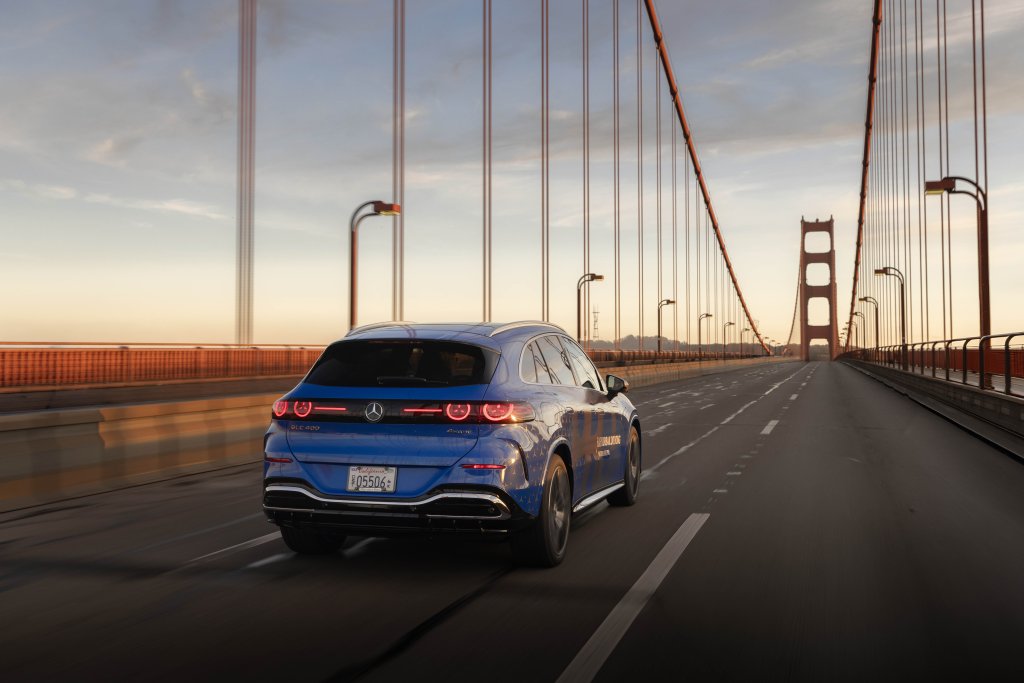
Mercedes-Benz will push out a complimentary OTA update to all owners of MB.OS equipped vehicles with MB.Drive Assist starting in early 2027. Mercedes is also currently distributing a survey to owners in California for an early access program for the Pro system and will distribute a test version by the end of 2026.
MB.Drive Assist Pro is planned to be made available nationally via subscription through the Mercedes app in the second half of 2027. There’s no pricing yet, but Mercedes-Benz North America CEO Jason Hoff indicated that it will likely be priced somewhere between the $49 per month charged by Rivian for Autonomy+ and the $99 price tag for FSD (Supervised).