Genesis GV90: Separate Luxury From Theater
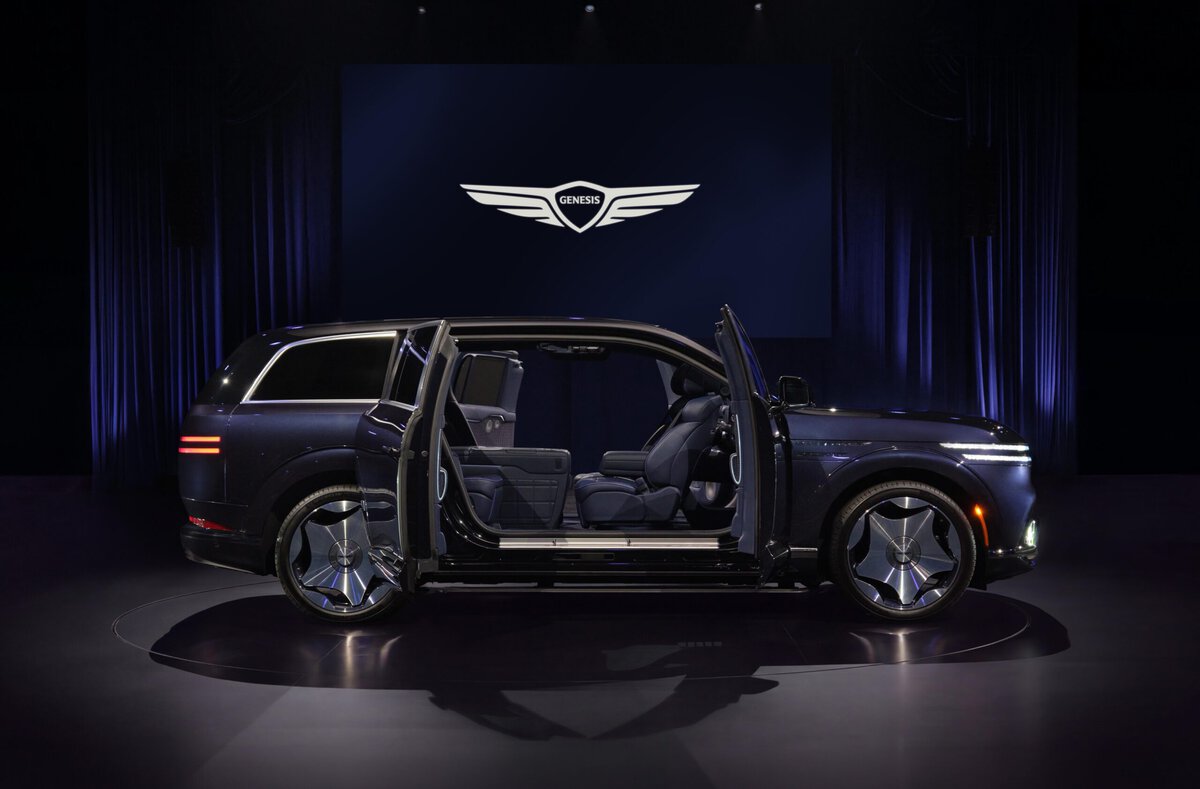
The Genesis GV90 offers coach doors, 657 hp and a 310-mile estimate, but price, EPA range and real-world polish will decide its value.
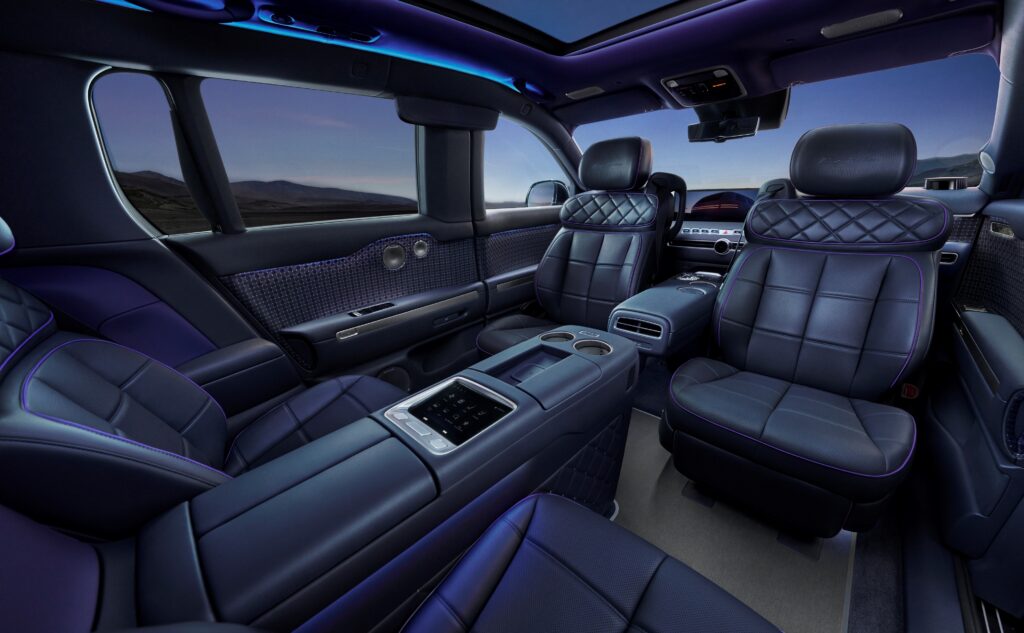
The most useful way to understand the 2028 Genesis GV90 is to separate the vehicle Genesis has confirmed from the fantasy its photographs encourage. Yes, the Neolun has coach doors with no fixed pillar interrupting the opening. Yes, front seats can turn around while parked, and the four-seat Executive Suite can add a refrigerator, tables and a heated wood floor. Britain already has enough drawing rooms, so I’m pleased Genesis looked to Korean hospitality for inspiration.
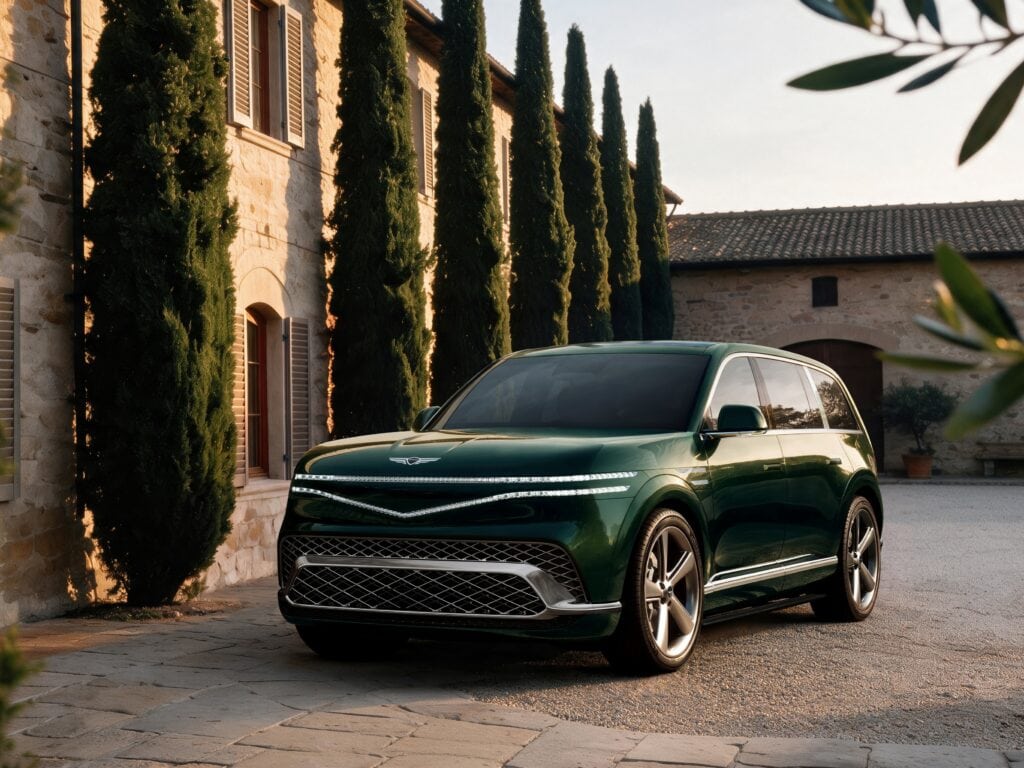
There is also a more conventional GV90 with normal doors and three rows. That model may become the bigger seller because families need seats and luggage room more often than they need to host a board meeting beside the school pickup line. Genesis now says the all-electric flagship will arrive in the United States in early 2027 as a 2028 model, offered in GV90, GV90 Neolun and limited Neolun First Edition forms.
I have spent time examining the vehicle, sitting in its front and rear compartments and working through its considerable feature list, but I have not driven it. That distinction matters. A stationary flagship can demonstrate materials, access and technology. It cannot prove ride quality, steering behavior, charging consistency, braking confidence or whether 657 horsepower arrives with the calm expected of an ultra-luxury SUV.
At 208.1 inches long with a 127.8-inch wheelbase, the GV90 is not a delicate object. Rear-wheel steering and remote parking could make it less intimidating, but physics has not received a hospitality upgrade. The same discipline applies to the estimated 310-mile range. Genesis produced that number in internal development testing for the seven-seater. The EPA has not marked the homework.
You may also enjoy this video:
Genesis GV90 Turns Hospitality Into Hardware
The most original part of the Genesis GV90 is not its horsepower. It is the attempt to turn the Korean idea of son-nim, treating a visitor as an honored guest, into useful engineering. On the Neolun, the rear door first slides outward and then rotates rearward. Both doors can operate independently, leaving a broad opening without a conventional fixed B-pillar.
That entrance should help children, older relatives and anyone loading a large dog, provided the dog does not interpret a Rolls-Royce-style arrival as permission to depart. We still need a published cargo volume and real measurements before discussing crates. Labradors are excellent journalists; they insist on evidence.
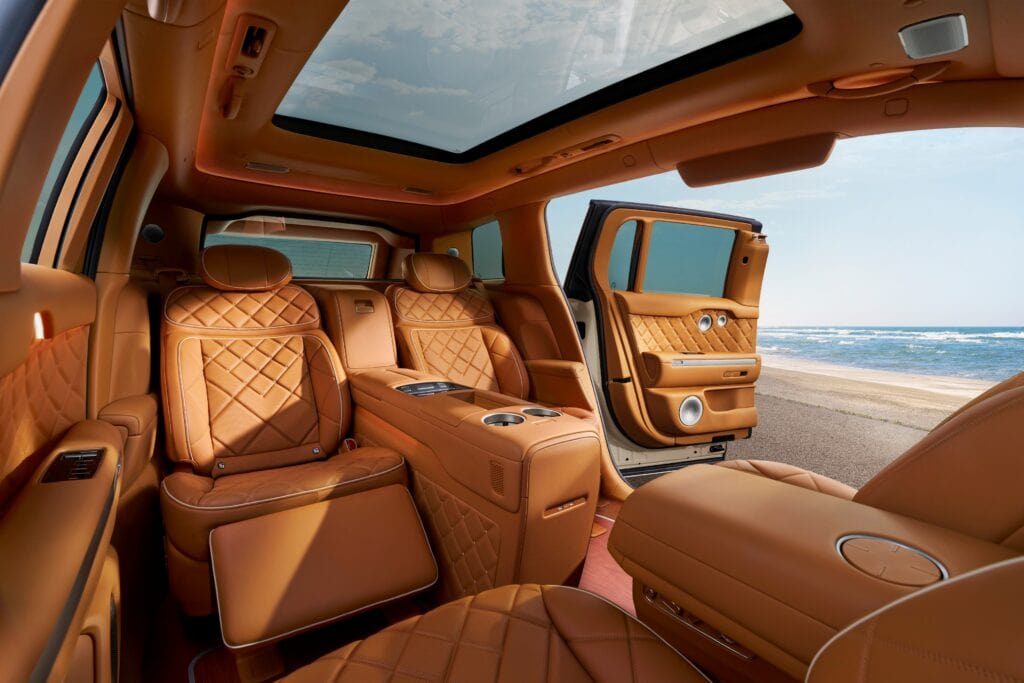
The available motorized front seats rotate 180 degrees only while parked. In its four-place Executive Suite form, the cabin brings two substantial rear chairs together with tables, chilled storage, window blinds and a luggage-area divider. A glass roof uses six independently adjustable transparency zones. Its genuine wood veneer floor contains radiant heating inspired by traditional Korean ondol construction, which warmed living spaces from underneath.
This matters because Genesis cannot build authority by offering a cheaper imitation of somebody else’s flagship. Leather, available wool cashmere, stone and wood establish material credibility, but the cultural idea gives those materials a reason to exist. Warm floors, radiant door panels and a quiet rear compartment serve people rather than decorating a specification sheet.
The catch is configuration. Launch images naturally favor the pillarless Neolun and four-seat cabin, while the regular GV90 uses conventional doors and a family-oriented layout. Shoppers should ask which features belong to the standard vehicle, which require Neolun and which are restricted to the limited First Edition. If the extraordinary details live only at a correspondingly extraordinary price, the value judgment changes.
You may also enjoy: Genesis GV80 Review: Quiet Luxury With Teeth
Range Rover Is the Benchmark, but Neolun Changes the Test
Range Rover Electric is the direct rival in philosophy: a full-size, quiet SUV selling privacy, presence and effortless travel. Rolls-Royce supplies the unavoidable coach-door comparison, yet its battery-powered Spectre is a coupe and Cullinan remains combustion-powered. The GV90 therefore enters an unusual opening between electric family utility and chauffeur-focused theater.
The standard version must compete with serious three-row EVs on space, charging, software and everyday comfort. Neolun faces a different examination. Its owner may compare the precision of the doors, rear-seat isolation, materials and personal service with vehicles carrying vastly older badges. The transaction becomes about social meaning and treatment as much as transportation.
That is why I would not frame the GV90 merely as Genesis skipping BMW and Mercedes. Those brands still offer relevant technical and luxury benchmarks. The sharper point is that Genesis refuses to stop at their level with its most elaborate version. Coach doors send a handwritten invitation to Rolls-Royce, while the size, proportions and electric mission point most directly toward Range Rover.
The challenge extends beyond the product. Ultra-luxury clients notice appointment handling, software failures, charging support, loan vehicles, personalization and the physical retailer. Genesis has more than 190 independent U.S. retailers, but a flagship buyer will judge whether the best of that network delivers one consistent experience. A flawless wood floor cannot soothe an avoidable service problem.
There is an advantage to being young. Genesis is free to define Korean luxury without protecting a century of British ritual. The restrained body draws from moon-jar forms, while the cabin emphasizes warmth and hosting. That is a stronger identity than competing through equipment quantity alone.
You may also enjoy: Inside the Rolls-Royce Scarcity Strategy
The 657-HP Claim Needs a Calm Reading
A flagship should make speed feel unhurried. Together, the GV90’s front and rear motors are rated at up to 657 horsepower; peak torque is 590 pound-feet. Electronic limited-slip differentials sit at both ends, distributing output for faster cornering and reducing wheelspin on rain, snow or uneven surfaces.
Those systems sound capable, but we have not driven the finished U.S. vehicle. The right question is not whether 657 horsepower can move it quickly. It is whether accelerator response, regenerative braking and body control remain smooth when passengers are using those elaborate rear seats. Numbers create attention; calibration creates luxury.
Rear-wheel steering can angle the back wheels up to five degrees. At low speeds, it is intended to reduce the turning circle to something resembling a midsize vehicle. At higher speeds, it should improve stability. Multi-chamber air springs adjust height and stiffness, while dual-valve electronically controlled dampers can soften sharp road impacts without allowing the body to wander through long movements.
The largest battery yet fitted to a Hyundai Motor Group EV has 123.5 kWh of capacity. Genesis says a suitable 350-kW charger can take it from 10 to 80 percent in 22 minutes. The U.S. Department of Energy explains that DC charging speed varies with station output, the vehicle and battery state of charge. Temperature and the charging curve will decide whether the GV90 can repeat its headline result on a real trip.
Genesis estimates approximately 310 miles for the seven-seat model. That is not yet an EPA-certified figure. The agency’s EV range-testing process produces standardized label information, allowing shoppers to compare vehicles more honestly. Range also says nothing by itself about energy efficiency. A 123.5-kWh pack traveling 310 miles has a different consumption story from a smaller battery covering the same distance.
The cabin attacks noise with acoustic glass more than five millimeters thick across every window and additional absorbers inside the structure. That should be valuable because an EV’s silent motors expose wind roar and tire slap. We will learn more after driving it over patched pavement, at freeway speed and in poor weather.
You may also enjoy: Lucid Gravity GT-S Packs 1,070 HP and Seven Seats
Roof Airbag and Hidden Pillar Deserve Scrutiny
Genesis calls its roof airbag the first fitted to a production vehicle. If sensors detect a serious rollover, the bag is meant to spread underneath the panoramic roof, limiting glass contact and helping stop occupants from being ejected. The broader idea predates the GV90: the Insurance Institute for Highway Safety notes that Hyundai Mobis introduced a panoramic-roof curtain airbag in 2017 after sunroof ejections had emerged as a concern.
Bringing that concept to customers could be significant. It is still a company claim until independent testing examines the complete vehicle. The GV90 has 12 airbags in total, including seat-cushion restraints intended to reduce submarining and curtains extending to the third row. The in-cabin monitoring system evaluates posture, passenger type and belt use so restraints can respond appropriately.
The Neolun doors deserve equal attention. A normal B-pillar provides a central structural path during side impacts and rollovers. Genesis says its alternative uses dual steel beams inside the doors, a concealed roll cage, high-strength tubes, structural foam and a cabin frame 1.5 times thicker than conventional construction. The manufacturer says the result matches the crash performance of a vehicle with a conventional pillar.
That is an ambitious engineering statement, not an independent result. Consumers should check the NHTSA 5-Star Safety Ratings and future IIHS evaluations once the 2028 model is tested. Responsibility remains standard equipment, but Genesis has supplied unusually interesting backup.
Battery engineering includes barriers intended to slow thermal propagation from one cell to the next, heat-dissipation measures and a cloud-based monitoring function that searches for abnormalities. Structural parts ahead of the pack are designed to move under the vehicle in a frontal collision rather than strike the battery directly. These protections should be evaluated through regulatory data, recalls and years of use, not simply admired at launch.
You may also enjoy: Genesis Powertrain Strategy Lets Buyers Choose
Who Should Wait for the Genesis GV90?
The technology is entertaining before the vehicle moves. Its 23.6-inch OLED display rises 90 millimeters while parked and becomes a 24.6-inch screen. Apparently televisions now need suspension travel. A 25-inch head-up display replaces the conventional gauge cluster and keeps speed, navigation and driver-assistance information in the driver’s view.
Pleos Connect is built on Android Automotive OS, an operating system integrated into the vehicle rather than projected from a phone. Genesis says its Gleo AI agent can handle natural conversation. Remote Smart Parking Assist 3 can maneuver the SUV during supported parking tasks, and Memory Reversing Assist records an entry path so the vehicle can follow it backward out of a narrow space.
Then there is the 25-speaker Bang & Olufsen system. Dolby Atmos support and a Virtual Venue setting can imitate Boston Symphony Hall or Wembley Stadium. Massage seats use 15 air cells, and radiant panels warm touchpoints around the passenger. This is the portion of the reveal that encourages one to ask whether the refrigerator contains anything more useful than sparkling water.
The sensible buyer is someone already comfortable with a large battery EV, able to charge at home and interested in a flagship that prioritizes silence and passenger care. The regular GV90 could fit a household needing six or seven seats. Neolun is for the customer who values the entrance and the rear cabin enough to accept added complexity and, almost certainly, a much larger price.
I would wait before placing either on a shopping list. We need pricing, EPA range, cargo measurements, towing and payload ratings, insurance information, final U.S. equipment and a drive. We also need to see whether the coach doors are graceful in a narrow parking space and whether the Executive Suite partition leaves enough room for actual luggage.
The GV90 has already succeeded as a declaration. Genesis is no longer asking to be graded on a curve because it is younger or likely to cost less. It wants this SUV judged as luxury, full stop. The design, materials and safety ideas justify taking that request seriously.
A purchase recommendation requires more. If the road manners, charging behavior, software and retailer experience match the ambition, the GV90 can become a credible Korean alternative to the ultra-luxury establishment. If any of those ordinary interactions feels unfinished, the coach doors will merely provide a larger opening through which disappointment may enter.
You may also enjoy: Genesis GV80 Coupe vs Defender: Why SUV Shape Matters