Hyundai Santa Fe EREV Leads a 58-Vehicle Blitz
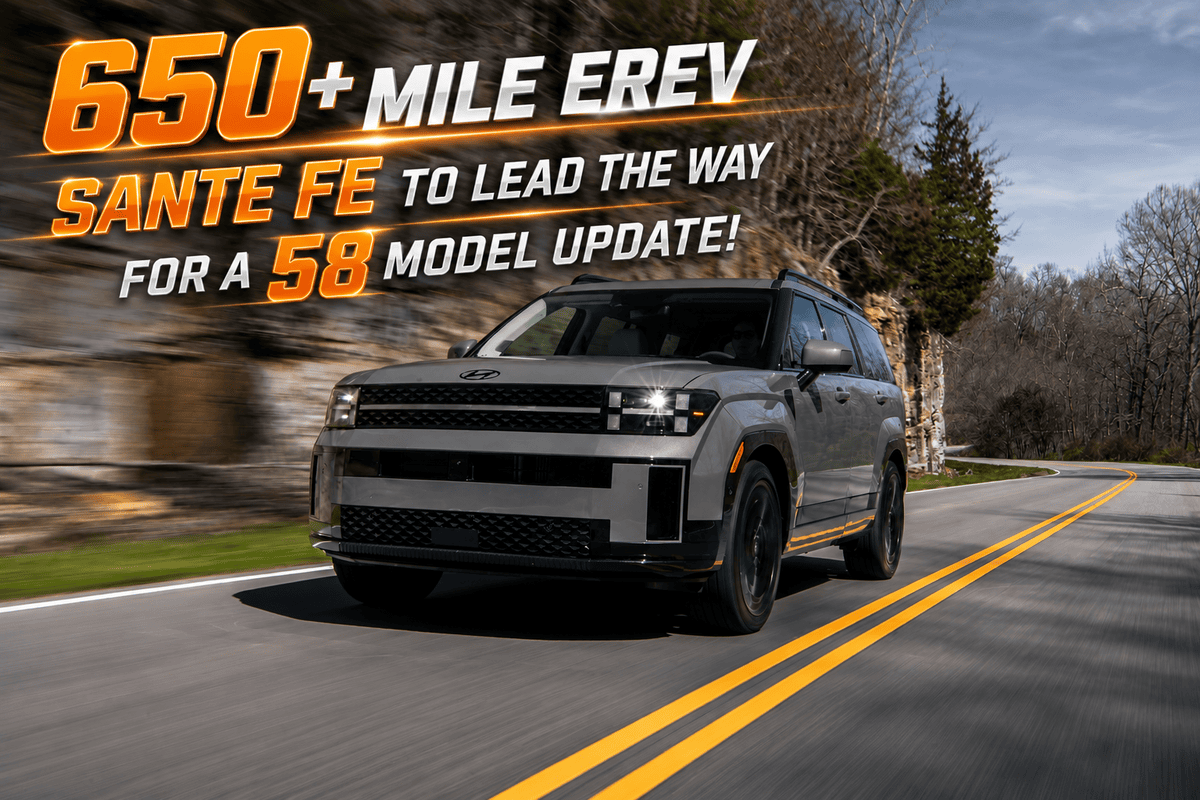
The Hyundai Santa Fe EREV could offer electric driving with road-trip security, but the specifications buyers need remain unanswered.
Hyundai Motor Company has announced 58 new or significantly updated vehicles for North America through 2030, but one familiar family SUV carries most of the practical intrigue. The Hyundai Santa Fe EREV is scheduled for production in Alabama during 2027, pairing an electric drivetrain with a gasoline engine that generates additional electricity.
That sounds like a neat answer to America’s imperfect charging network. It may be. The problem is that Hyundai has announced the solution before revealing the numbers that will tell shoppers how useful it actually is.
Hyundai Santa Fe EREV Needs Five Crucial Numbers
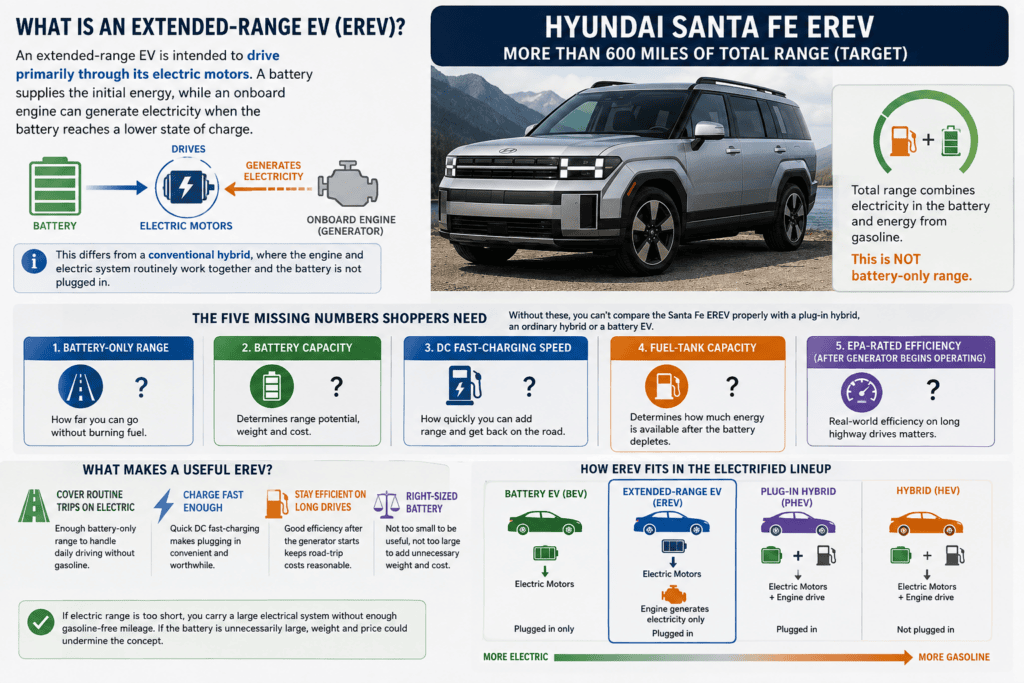
An extended-range EV is intended to drive primarily through its electric motors. A battery supplies the initial energy, while an onboard engine can generate electricity when the battery reaches a lower state of charge. This differs from a conventional hybrid, where the engine and electric system routinely work together and the battery is not plugged in.
Hyundai has previously discussed more than 600 miles of total range for its EREV family. That is not battery-only range. It combines electricity stored in the battery with the energy carried as gasoline, so the larger number should not be confused with the distance owners can travel without burning fuel.
You may also enjoy: Nissan e-POWER Could Help Save Nissan
The first missing number is battery-only range. The others are battery capacity, DC fast-charging speed, fuel-tank capacity and EPA-rated efficiency after the generator begins operating. Without them, shoppers cannot compare the Santa Fe EREV properly with a plug-in hybrid, an ordinary hybrid or a battery EV.
A useful EREV should cover many routine journeys without gasoline, charge quickly enough to make plugging in worthwhile and maintain acceptable efficiency on long highway drives. If its electric range is too short, owners will carry a large electrical system without receiving enough gasoline-free mileage. If the battery is unnecessarily large, weight and price could undermine the concept.
Why Hyundai’s Approach Could Fit American Families
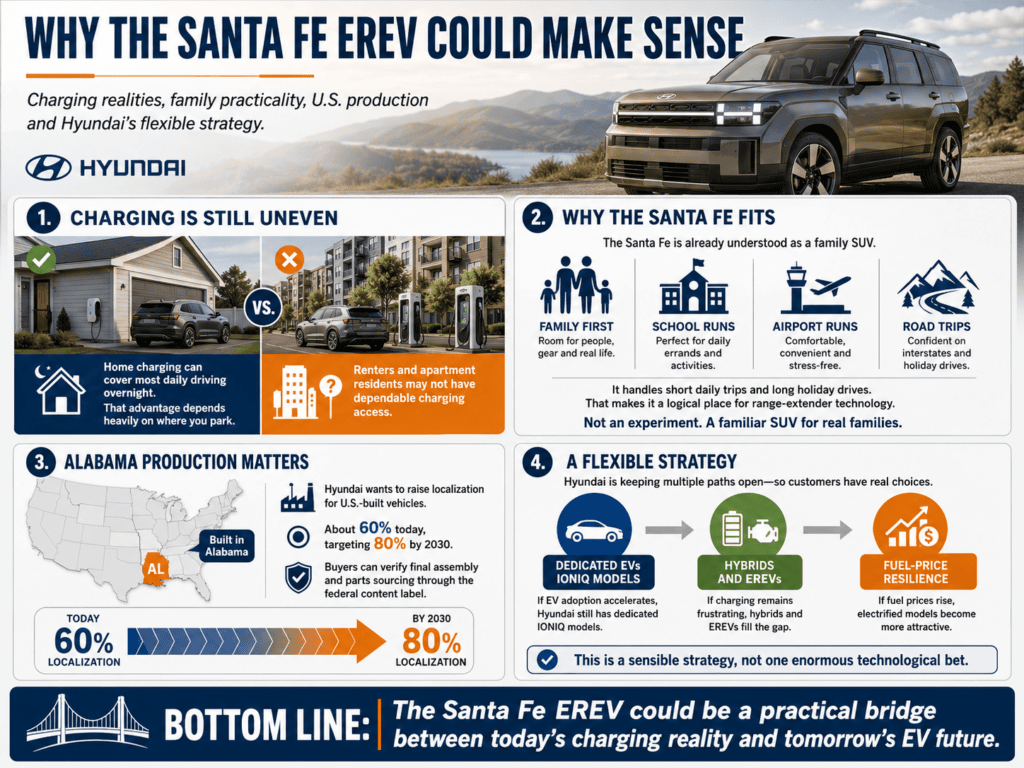
Public charging remains an uneven ownership experience. Drivers with home charging can handle most daily mileage overnight, while renters and apartment residents may not have dependable access. The federal Alternative Fuels Data Center explains how home charging can meet many owners’ regular driving needs, but that advantage depends heavily on where someone parks.
The Santa Fe is a clever place to introduce the technology. It is already understood as a family SUV rather than an experiment requiring customers to learn an unfamiliar name. It serves the school run, airport trip and interstate holiday, precisely the mix of short and long travel where a range-extender could make sense.
You may also enjoy: SUV Showdown: Palisade vs Telluride vs Grand Highlander
Alabama production also matters. Hyundai says it wants to raise localization for U.S.-built vehicles from about 60 percent to 80 percent by 2030. Buyers will eventually be able to check final assembly and parts sourcing through the federally required content label, which is more useful than simply accepting an “American-made” slogan.
The strategy gives Hyundai protection against several possible futures. If EV adoption accelerates, it still has dedicated IONIQ models. If charging continues to frustrate drivers, it has hybrids and EREVs. If fuel prices rise, electrified versions become more attractive. That flexibility is less dramatic than making one enormous technological bet, but considerably more sensible.
The 58-Vehicle Number Requires Context
Hyundai’s headline figure includes 36 Hyundai vehicles and 22 Genesis products. These are product actions, not 58 completely new nameplates. Redesigns, major updates, added powertrains and entries into new segments all contribute to the total.
You may also enjoy: Genesis Wants to Scare BMW With 22 New Vehicles
That distinction does not make the plan small. Hyundai is preparing a new Tucson and Tucson Hybrid, additional high-performance vehicles, more region-specific products and the extended-range Santa Fe. Genesis will add hybrids, EREVs, electric flagships and Magma performance models.
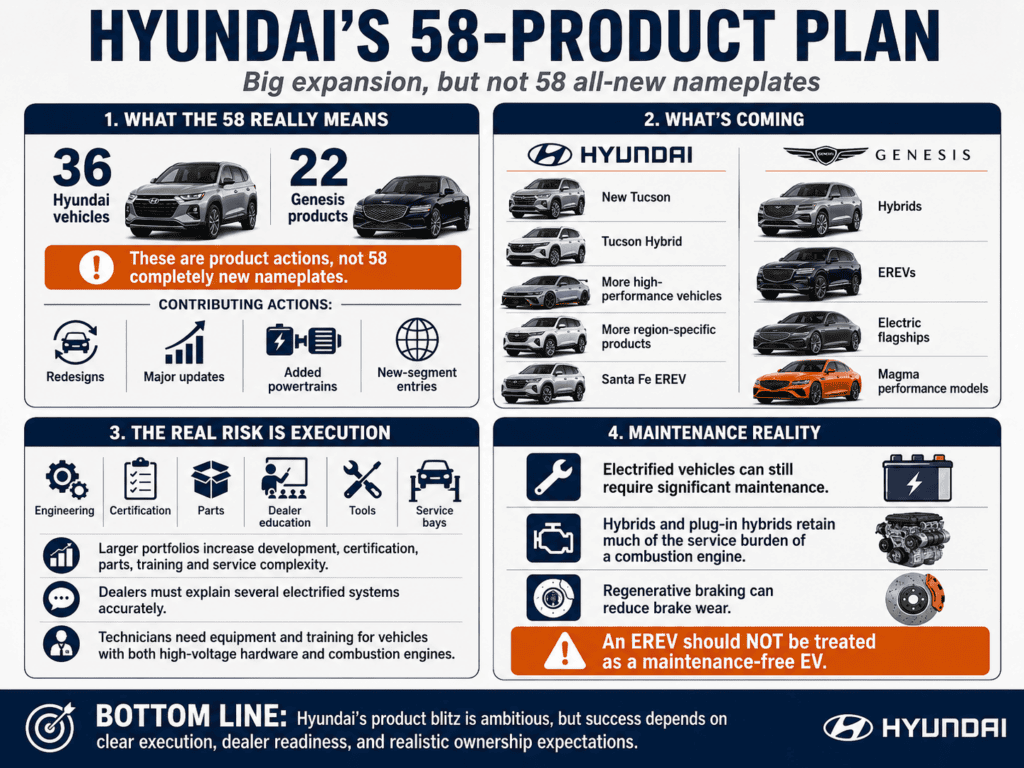
The risk is execution. A larger portfolio increases development, certification, parts, training and service complexity. Dealers must explain several electrified systems accurately, while technicians need equipment and training for vehicles carrying both high-voltage hardware and combustion engines.
Electrified vehicles can also have different maintenance requirements. Federal guidance notes that hybrids and plug-in hybrids retain much of the service burden associated with a combustion engine, even though regenerative braking can reduce brake wear. The government’s maintenance comparison is a useful reminder that an EREV should not be treated as a maintenance-free EV.
You may also enjoy: 2027 Kia Telluride Hybrid Is Big, Bold and Family Ready
The Genesis GV80 Hybrid Corrects an Important Number
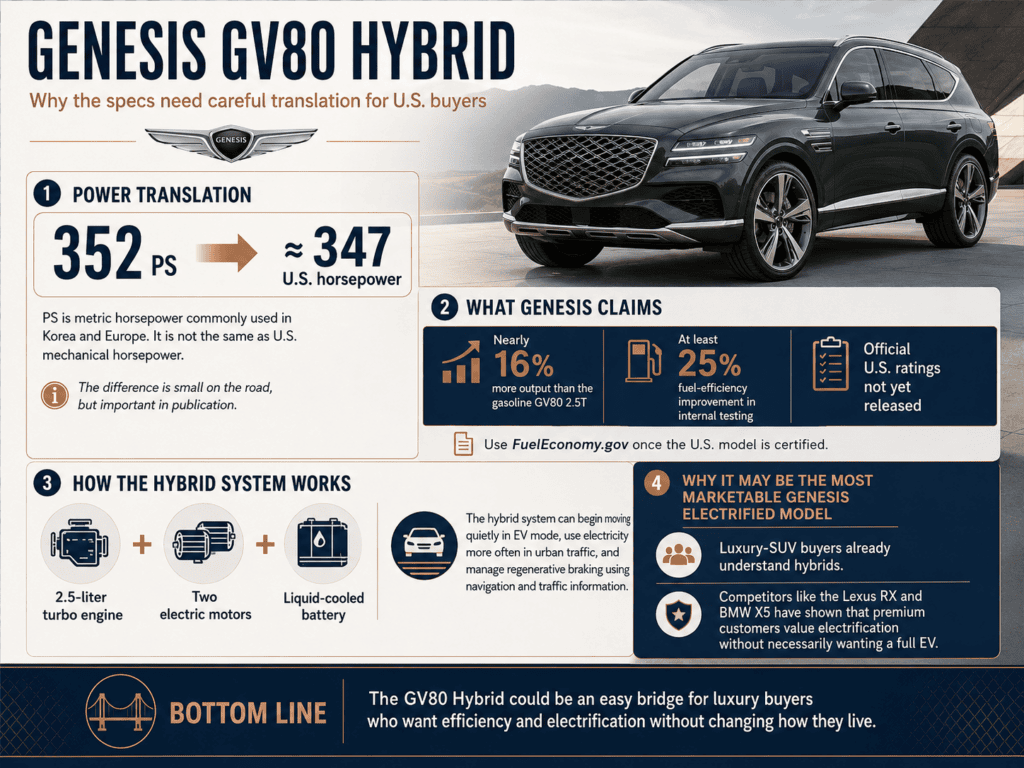
The first Genesis hybrid provides another example of why American specifications require careful translation. Genesis lists the GV80 Hybrid at 352 PS, a metric horsepower measurement commonly used in Korea and Europe. That converts to approximately 347 U.S. mechanical horsepower, not 352 horsepower.
The difference is small behind the wheel but important in publication. Genesis says the system delivers almost 16 percent more output than the gasoline GV80 2.5T and produces at least a 25 percent fuel-efficiency improvement in internal testing. Official U.S. ratings have not been released, so shoppers should use FuelEconomy.gov once an American model is certified.
You may also enjoy: Genesis GV80 Coupe vs Defender: Why SUV Shape Matters
The GV80 Hybrid uses a liquid-cooled battery and two electric motors integrated with a 2.5-liter turbocharged engine. Genesis claims it can begin moving quietly in EV mode, use electricity more frequently in urban traffic, and manage regenerative braking according to navigation and traffic information.
This may be the more immediately marketable vehicle. Luxury-SUV customers already understand hybrids, and competitors such as the Lexus RX and BMW X5 have demonstrated that premium buyers value electrification without necessarily wanting a fully electric vehicle.
The Buyer Verdict Comes Later
Hyundai’s broad strategy is convincing. The individual buying case is not complete. The Santa Fe EREV could become one of the most useful electrified family SUVs in America, but only if its electric range, charging performance, gasoline efficiency and price support the promise.
Do not shop the claimed total range alone. Ask how far it travels before using gasoline, how quickly the battery charges, what happens to efficiency at highway speeds and whether the generator can maintain performance while climbing or towing.
Those answers will determine whether Hyundai has built a genuine bridge between EVs and hybrids or simply installed both sets of compromises in one vehicle. The 58-vehicle offensive is major news. For families, the Hyundai Santa Fe EREV will become important only when Hyundai supplies the five numbers missing from the presentation.