Mercedes-Benz NVIDIA Deal: What Drivers Should Know
The Mercedes-Benz NVIDIA partnership is expanding automated driving research, but drivers should distinguish future ambitions from features they can buy.
Mercedes-Benz is putting more of its automated-driving future in NVIDIA’s hands. The companies announced an expanded partnership October 16, 2026, combining Mercedes-Benz vehicle engineering and MB.OS software with NVIDIA computing, sensors and artificial intelligence. It is a significant technical commitment, but it comes with an important asterisk for anyone shopping for a car today: a development announcement is not a promise that a new Mercedes can drive itself home.
You may also like this video:
What the Mercedes-Benz NVIDIA partnership actually changes
The arrangement is broader than adding a more powerful computer beneath the dashboard. Mercedes-Benz says its MB.OS operating system will work with NVIDIA Hyperion, a vehicle-computing and sensor architecture. NVIDIA’s Alpamayo Stack contributes automated-driving software designed to reason through complicated road situations. NVIDIA Halos adds a safety framework with a parallel safety stack, redundancy and safeguards.
Think of those elements as a coordinated system: the vehicle has to sense what is happening, interpret the scene, decide what to do and check that the proposed action is safe. Putting these functions together is considerably harder than drawing a route on a map. An automated system has to understand that a child standing beside a crosswalk is not the same situation as a traffic cone at the curb.
The announcement describes future urban point-to-point driving assistance, active-safety capabilities and automated parking. It also identifies future SAE Level 4 applications, including driverless luxury transport services, as an area of development. It does not specify a launch date, a U.S. model lineup, subscription prices or the roads on which new capabilities would be permitted.
You may also enjoy: 2027 Mercedes-Benz GLE: The Smart Family Luxury SUV?
The difference between assistance and real autonomy
Drivers have heard the phrase self-driving for years, often attached to systems that still demand human supervision. The National Highway Traffic Safety Administration distinguishes features that help motorists steer and manage speed from systems that assume responsibility for driving. It is a distinction worth making before discussing any new artificial-intelligence feature.
Under the SAE driving automation framework, Level 2 assistance requires continuous driver monitoring. Level 3 can handle the driving task in defined conditions, with a human available to resume control when requested. Level 4 does not depend on a human to take over within its approved operating conditions. Those conditions may be geographically or operationally limited; Level 4 does not mean a vehicle can travel anywhere, in any weather.
That distinction is particularly relevant to the proposed robolimousine applications. A vehicle able to carry passengers without a supervising driver inside a defined service area is a very different proposition from a privately owned SUV offering steering assistance on the freeway. The news release connects the companies’ technology to that longer-term goal, without saying the goal has already been reached.
You may also enjoy: Robotaxi Privacy: What Waymo and Tesla Record
Why the safety architecture deserves attention
NVIDIA calls its safety system Halos, and Mercedes-Benz emphasizes its own engineering and safety expertise. The interesting part is the reference to a parallel safety stack: the companies are discussing checks and safeguards alongside the intelligence making driving decisions. That is the right question for engineers to address when software is expected to make judgments among cyclists, pedestrians and turning vehicles.
Still, no amount of reassuring terminology substitutes for validation. The Insurance Institute for Highway Safety’s safeguards program evaluates whether current assisted-driving systems keep drivers engaged, issue effective warnings and respond safely when motorists fail to pay attention. Its tests concern partial automation, not certification of this proposed NVIDIA-based system, but they illustrate why safety depends on behavior rather than branding.
Federal policy also places emphasis on transparency and safety evaluation. The U.S. Department of Transportation’s automated-vehicle work covers testing, deployment and public understanding of automated systems. The department’s September 2026 national strategy addresses the regulatory environment for automation. Neither government initiative constitutes an approval of the newly announced Mercedes-Benz and NVIDIA technology.
You may also enjoy: Cadillac Eyes-Off Driving Is Coming in 2028
Software updates can help, but they don’t answer every question
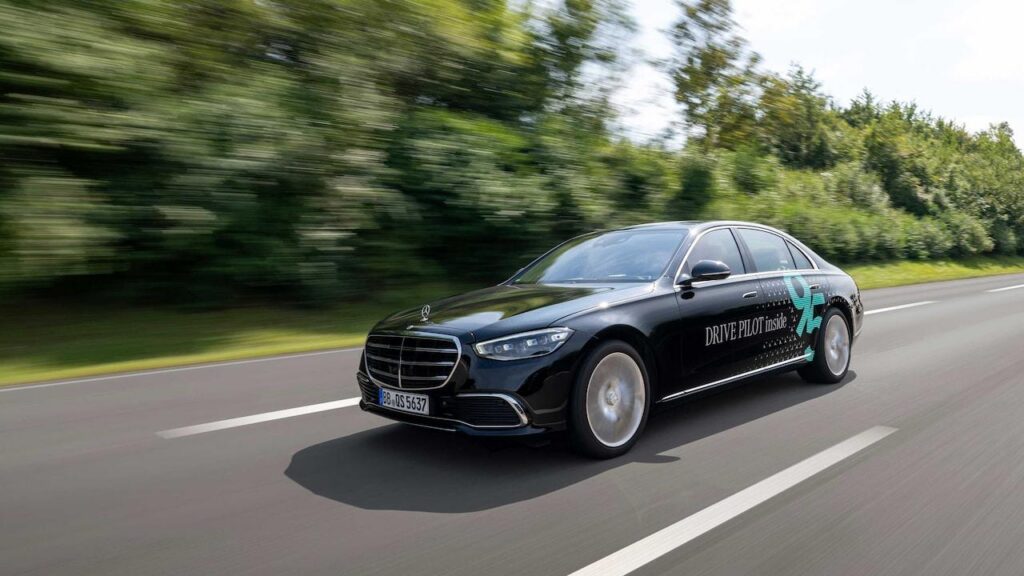
MB.OS supports over-the-air software updates, an important part of the companies’ approach. Software-defined vehicles can receive revisions after delivery, although whether a particular function can be added depends on hardware, testing, market regulations and what the manufacturer actually offers. Owners should not assume an existing Mercedes will eventually receive new automated-driving abilities simply because it has a connected operating system.
Buyers should ask three practical questions: Which features are operational on this exact model today? Under what conditions can they be used? What does the driver still have to supervise? A fourth question matters for long-term ownership: what is included in the vehicle’s price, and what requires payment later? Mercedes-Benz did not provide those commercial details in this announcement.
We have seen the broader industry wrestle with those same questions as artificial intelligence moves from infotainment into vehicle control. More sophisticated software may eventually reduce routine driving work, but the limits need to be as clear to families as the advantages. Nobody should have to read a computer-engineering paper to learn who is responsible at the next intersection.
You may also enjoy: Hyundai Driving AI in 2028: What Will Drivers Get?
The bigger bet: building the system, not just the car
The Mercedes-Benz and NVIDIA expansion illustrates a strategic change in the auto business. A premium vehicle is increasingly defined by its sensors, computing platform, software maintenance and the ability to demonstrate trustworthy behavior under difficult conditions. The companies want their combined systems to span everyday assistance and, in the future, much more demanding driverless services.
That ambition has competitors asking similar questions about where control of the vehicle’s intelligence should sit. Automakers bring knowledge of real-world durability, service networks and crash engineering; technology firms contribute computing and software platforms. A strong partnership may speed development, but the driver ultimately experiences one integrated product, not two separate corporate résumés.
You may also enjoy: The Hidden Cost of AI May Be Your Next Car
Shopping note: For readers also thinking about everyday cabin protection, Shop OEDRO directly or Shop OEDRO on Amazon for all-weather floor mat options. Use code NIKM20 at the OEDRO official store. Test Miles may earn a commission from purchases made through these affiliate links.
What matters next for Mercedes-Benz customers
The test of this announcement will be much less glamorous than a futuristic driverless limousine: clear model-by-model availability, dependable operation in complicated traffic, honest communication about limitations and convincing safety evidence. Mercedes-Benz and NVIDIA have outlined the pieces they intend to combine. Until vehicles, operating areas, timelines and independent results are disclosed, the sensible response is interest rather than assumption. The next generation of driving assistance may be very clever. It still has to prove that it knows what it is doing.