A Brief History of Automotive Tires, From Air to AI
Modern automotive tires look deceptively ordinary: a black ring filled with air. In reality, it carries weight, absorbs impacts, transmits power, and creates the grip that allows a car to turn and stop.
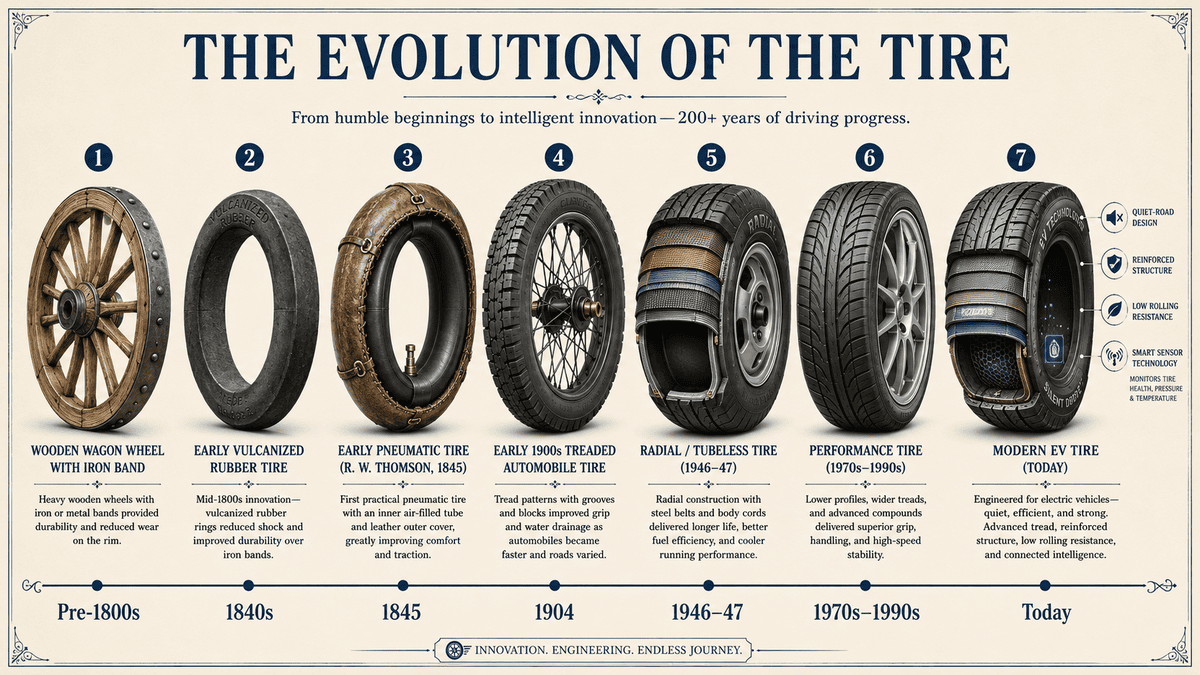
That sophistication took nearly two centuries. The automotive tire was not one invention, but a chain of breakthroughs involving chemistry, compressed air, reinforcing cords, steel belts, tread design and electronic sensors.
Charles Goodyear, Robert William Thomson, John Boyd Dunlop, André and Édouard Michelin, Harvey Firestone and Marius Mignol helped transform the tire from a metal band into an engineered safety system.
You may also like: BFGoodrich Doubles Down on Tires: Are These the Only Two You’ll Ever Need?
From Metal Bands to Vulcanized Rubber
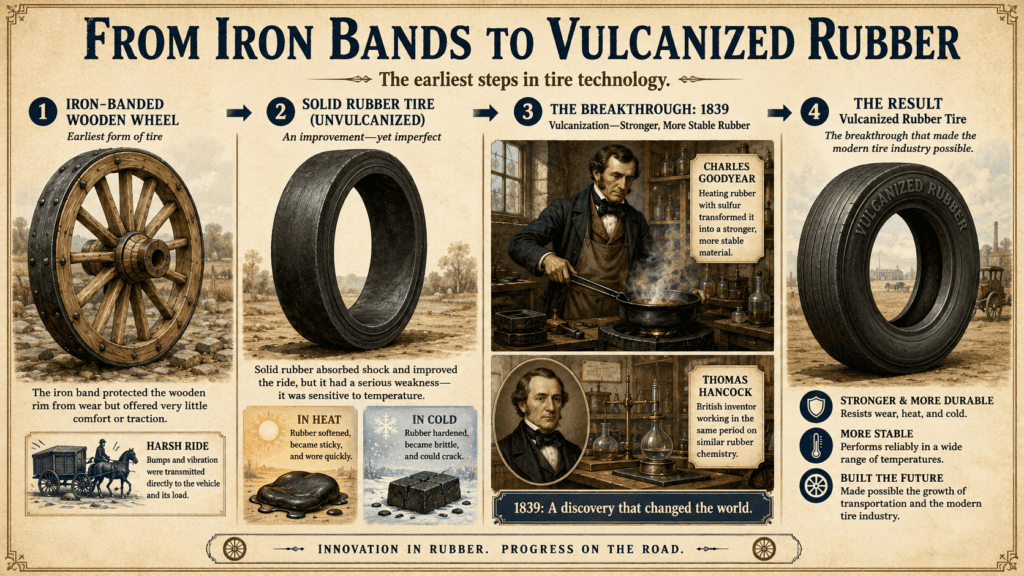
For centuries, a tire was an iron or steel band around a wooden wagon wheel. It protected the rim but offered little comfort or traction. Solid rubber improved the ride, although natural rubber softened in heat and hardened in cold weather.
Charles Goodyear’s 1839 discovery of vulcanized rubber changed that. Heating rubber with sulfur created a stronger, more stable material. British inventor Thomas Hancock developed similar chemistry during the same period. Without vulcanization, the modern tire industry could not have existed.
You may also like: Ford Explorer Tremor Is Built for Bad Weather
The First Practical Pneumatic Tires
Scottish inventor Robert William Thomson patented an air-filled tire in 1845, placing an inflated tube inside a protective covering. His idea worked, but cost and primitive roads prevented widespread adoption.
John Boyd Dunlop revisited the concept in Belfast in 1888 while improving his son’s tricycle. Racing victories proved pneumatic tires were smoother and faster. Businessman Harvey du Cros helped commercialize the design.
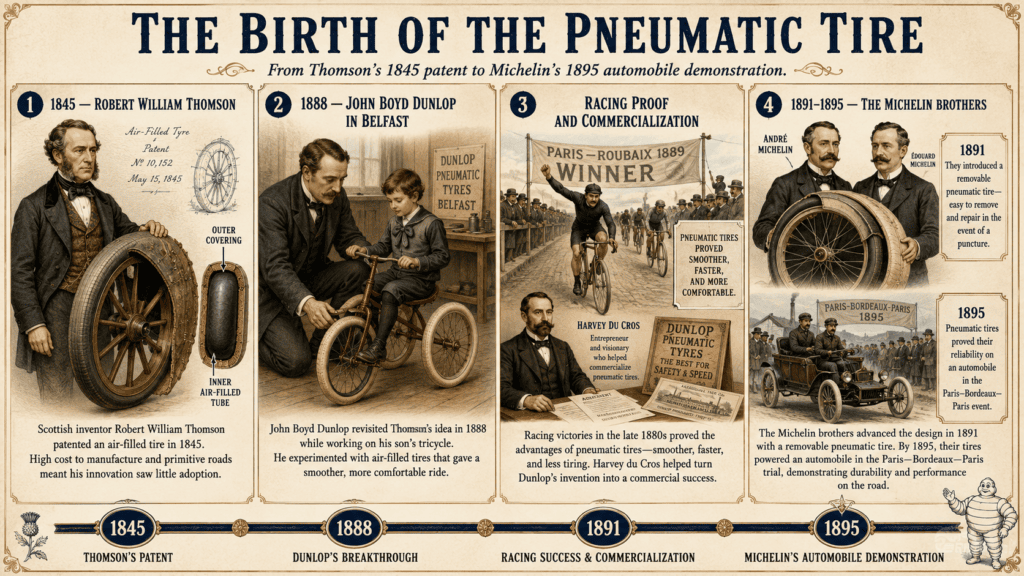
The Michelin brothers advanced it in 1891 with a removable pneumatic tire. A puncture no longer required the tire to be laboriously fixed to the wheel. By 1895, Michelin was demonstrating pneumatics on an automobile in the Paris-Bordeaux-Paris event.
You may also like: Winter Driving Myths That Keep Causing Crashes
Tread, Winter Grip and Stronger Construction
Early tires were often nearly smooth. Continental introduced an automotive tread pattern in 1904, improving grip on wet, dirty and snowy roads. Grooves, blocks and later small cuts called sipes became essential for moving water and finding traction.
Manufacturers added carbon black to strengthen tread rubber and replaced woven fabric with reinforcing cords. Firestone’s gum-dipping process reduced friction and heat, while Nokian introduced a dedicated winter truck tire in 1934.
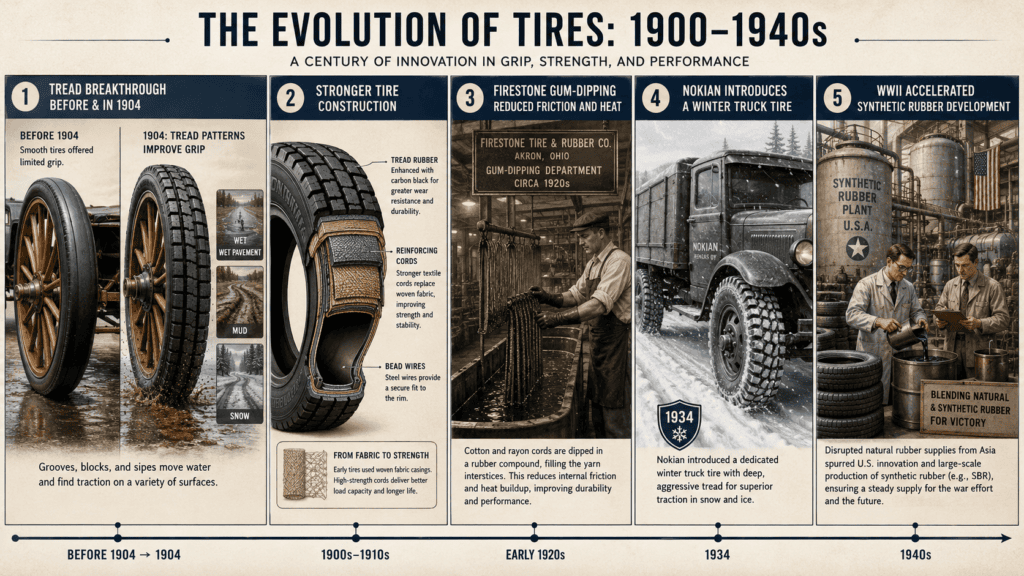
World War II accelerated synthetic-rubber development after Asian supplies were disrupted. American chemical, petroleum and tire companies created large-scale production methods, allowing engineers to blend natural and synthetic rubber for durability, grip and heat resistance.
You may also like: 2027 Toyota Tundra Adds Trailhunter Package
Radial and Tubeless Tires Changed Everything
Michelin engineer Marius Mignol developed the architecture behind the radial tire, patented in 1946. Its body cords ran across the tire while steel belts stabilized the tread. Compared with bias-ply construction, radials generated less heat, lasted longer, reduced rolling resistance and handled more consistently.
BFGoodrich introduced a commercially successful tubeless automobile tire in 1947. An airtight liner replaced the separate tube, reducing weight and eliminating a common failure source. Both technologies eventually became passenger-car standards.
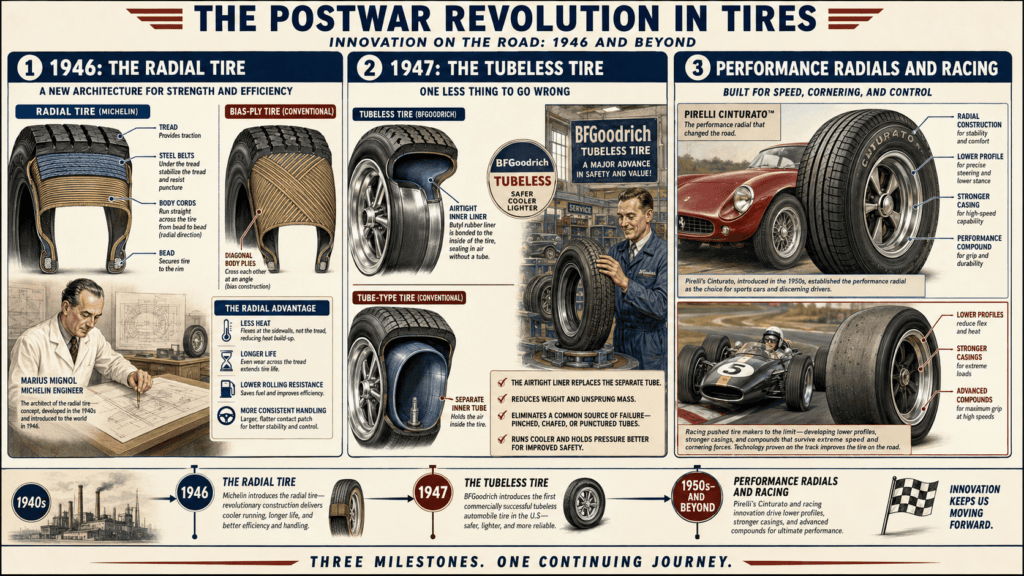
Pirelli’s Cinturato helped establish the performance radial, while racing pushed manufacturers toward lower profiles, stronger casings and compounds capable of surviving extreme speed and cornering.
You may also like: I Replaced My EV Tires and It Transformed the Drive
EVs and Smart Tires Define the Future
Silica-rich compounds in the 1990s improved the balance between wet grip and rolling resistance. In the 2000s, pressure monitoring systems warned drivers about dangerous underinflation.
Electric vehicles need tires capable of carrying battery weight, resisting instant torque, limiting road noise and conserving range. Manufacturers are also developing sensors that estimate temperature, load, wear and available grip.
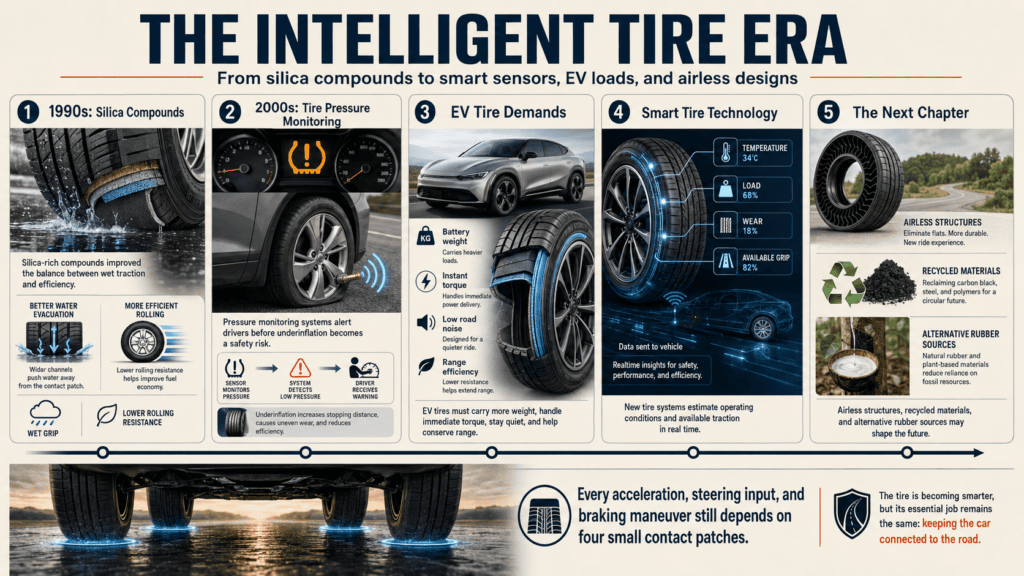
Airless structures, recycled materials and alternative rubber sources may shape the next chapter. Yet every acceleration, steering input and braking maneuver still passes through four small contact patches. The tire may be increasingly intelligent, but its greatest achievement remains quietly keeping the car connected to the road.