Genesis EREV: What Its 640+ Mile Range Really Means
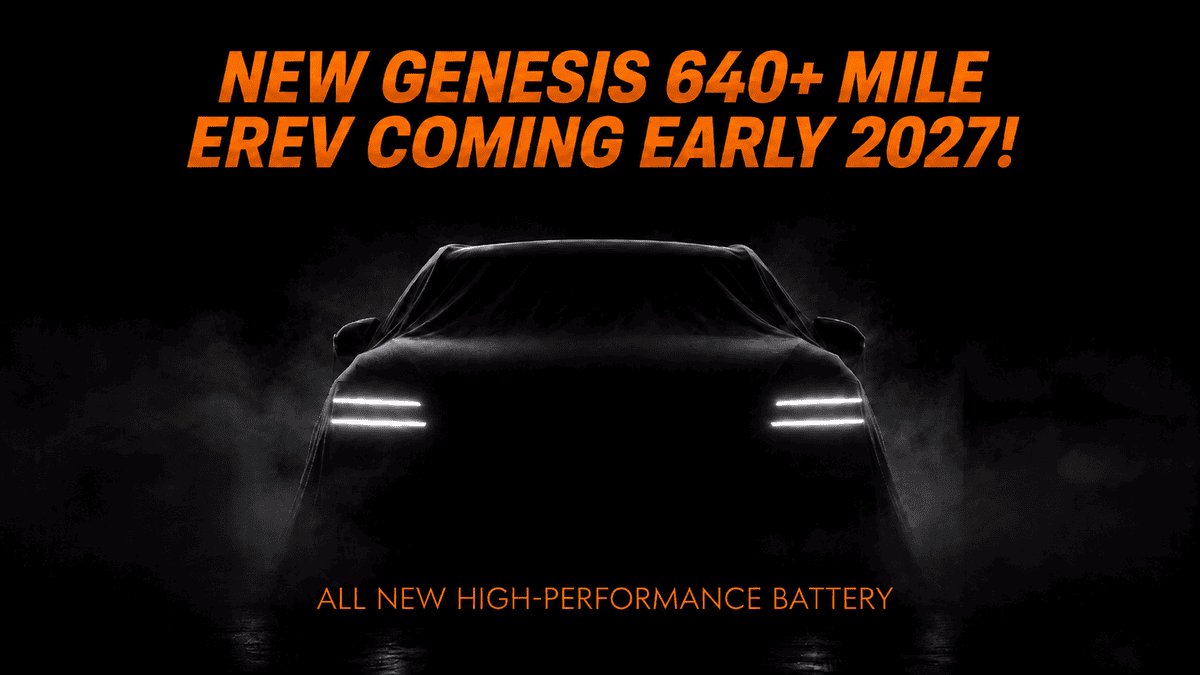
Genesis EREV promises 640+ miles, but that is total range, not 640 electric miles. Here is what buyers should know before the 2027 launch.
Genesis EREV headline needs a very important footnote
A number like 640 miles is almost guaranteed to dominate the conversation around the upcoming Genesis EREV. It is also the number most likely to be misunderstood.
Genesis says the extended-range model is due early in 2027, targets 640-plus miles of total travel, and will use a newly developed high-performance battery. The brand’s own recent description of EREV technology makes clear that this is total driving range, combining battery energy with gasoline used by the onboard range extender. It is not a claim that the vehicle will travel 640 miles on battery power alone.
That distinction changes the story. This is not Genesis suddenly finding a battery with more than twice the usable range of today’s luxury EVs. It is Genesis trying to give drivers electric-motor propulsion for normal use while keeping a second source of energy onboard for the occasional journey that would otherwise require a charging stop.
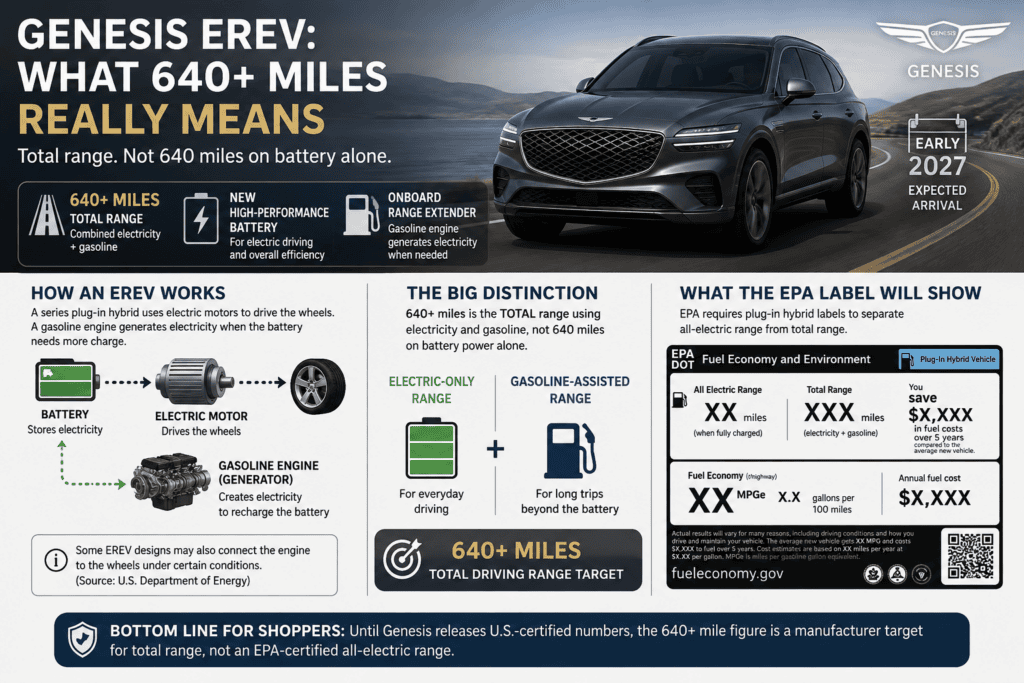
The U.S. Department of Energy explains that a series plug-in hybrid can use its electric motor to drive the wheels while an internal-combustion engine generates electricity. DOE notes that these vehicles are often described as extended-range electric vehicles, although some designs may connect the engine to the wheels under certain conditions.
For shoppers, the eventual EPA label will be essential. The EPA’s plug-in hybrid label guidance separates all-electric range from total range using electricity and gasoline. Until Genesis publishes U.S.-certified numbers, the 640-plus-mile figure is best understood as a target for the complete vehicle, not an EPA-certified electric-range figure.
You may also enjoy: 2026 Genesis GV70 3.5T AWD: Best Luxury Crossover?
The product chart leaves a GV70-sized clue
The most interesting detail in Hyundai Motor Company’s presentation may not be on the dedicated EREV slide at all. It appears later, in a graphic showing the future Genesis lineup.
That chart places an “Extended Range EV” derivative in the GV70 portion of the portfolio. The dedicated EREV slide does not actually name the vehicle, so Test Miles would not treat the graphic as the same thing as a formal Genesis GV70 EREV announcement. Still, it is a meaningful clue about where this technology may be headed.
A GV70 EREV would be a logical choice. Genesis already sells the GV70 with conventional gasoline power and as the Electrified GV70. The 2026 Electrified GV70 carries an EPA-estimated 263 miles of range, according to Genesis’ U.S. product information. That makes the compact luxury crossover a useful reference point for understanding the new powertrain.

If the EREV can cover daily use mostly on electricity, then switch to onboard generation for long trips, it addresses the exact circumstance that still gives some buyers pause about a full EV. There is no need to claim that charging infrastructure is universally inadequate. Many EV owners charge at home and rarely visit a public charger. The issue is that the exceptions matter when somebody is spending luxury-car money.
The Department of Energy’s battery-electric vehicle overview notes that EV range varies with driving conditions and that charging availability remains part of the ownership equation. A customer who drives 40 miles on a normal day and 500 on a holiday weekend has very different requirements from someone whose car rarely leaves a metropolitan area.
You may also enjoy: Genesis Wants to Scare BMW With 22 New Vehicles
Who should actually want this powertrain?
The Genesis EREV makes the strongest case for itself when you imagine a specific owner rather than an abstract EV buyer.
Consider someone with a garage and reliable home charging who wants the quiet response of electric motors during the week, but regularly drives between cities or into areas where fast chargers are sparse. That owner could plug in every night and potentially complete much of normal life without burning gasoline. On the occasional longer trip, the vehicle could generate electricity onboard instead of forcing the itinerary to follow charging locations.
That sounds attractive, but we need one missing number before recommending the concept strongly: electric-only range. Genesis has not disclosed it for this vehicle. If the battery covers a large share of normal daily travel, the range extender becomes an insurance policy that may run infrequently. If the battery is comparatively small, gasoline operation could become routine for many owners.
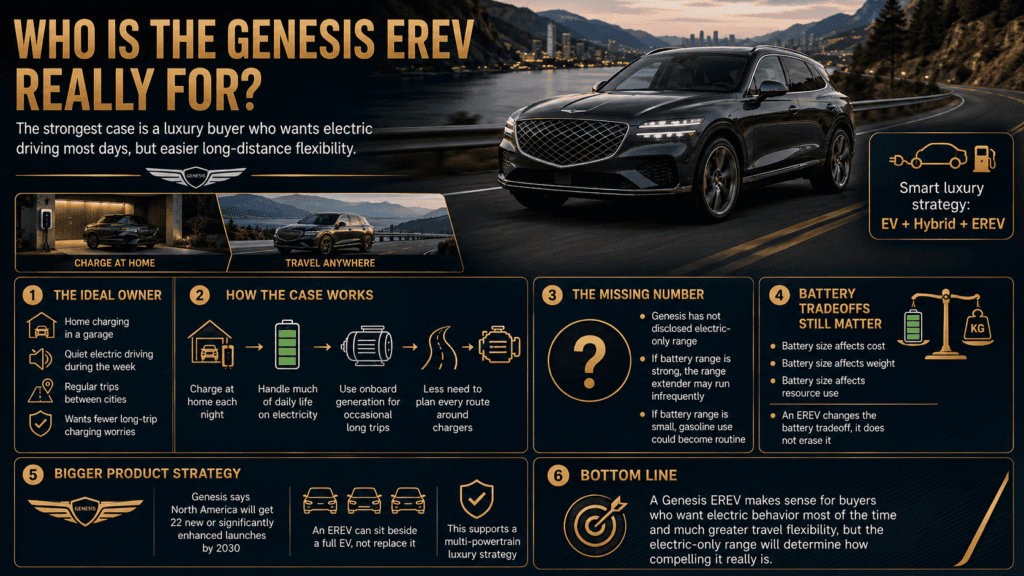
Battery size also affects cost, weight and resource use. The Department of Energy’s battery guide explains the central role of battery packs in electric vehicles and the continuing work around performance, life and recycling. An EREV does not eliminate battery tradeoffs. It changes how much battery capacity a vehicle may need to carry to satisfy long-distance expectations.
Genesis is making this move in the middle of a broader product expansion. The company says North America will receive 22 new or significantly enhanced Genesis vehicle launches through 2030, spanning vehicles, powertrains, trims and derivatives. That means the EREV does not have to replace the battery EV. It can sit beside it.
This is the smarter interpretation of a multi-powertrain luxury strategy. Give the customer a full EV if that fits. Offer hybrid technology where it makes sense. Add an EREV for the buyer who wants electric behavior with a much larger travel envelope.
You may also enjoy: Genesis GV90 Takes Aim at Rolls-Royce and Range Rover
The tradeoffs no 640-mile number can erase
EREVs solve one problem by adding another system to the vehicle. You still have a traction battery, power electronics and electric motors, but now there is also an internal-combustion engine, fuel system, exhaust system and associated controls. That can mean additional packaging demands, maintenance items and engineering complexity.
There is also no guarantee that operating on the range extender will be as quiet as driving on battery power. Luxury customers will notice vibration, engine speed changes and noise that would be unremarkable in a mainstream vehicle. Genesis will have to make the transition from stored battery energy to generated electricity feel appropriately expensive.
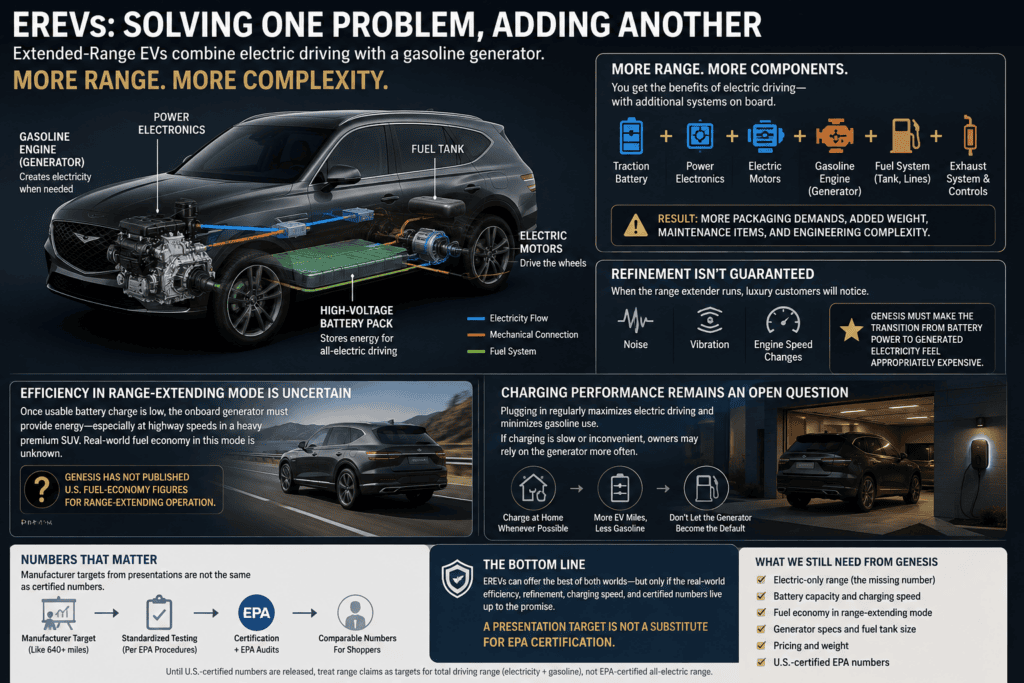
Efficiency once usable battery charge has fallen to its lower limit may prove even more important. Carrying a premium SUV at highway speed requires real energy. Genesis has not yet supplied a U.S. fuel-economy figure for range-extending operation, so there is no responsible way to say how economically those later miles will be delivered.
Charging performance is another open question. An EREV owner should still be encouraged to plug in, because regular charging is what allows the vehicle to spend the greatest amount of time operating from grid electricity rather than gasoline. If charging speed is slow, owners may become more tempted to treat the gasoline generator as the default solution.
The EPA’s explanation of fuel-economy and EV-range testing is worth remembering here. Manufacturer testing follows standardized procedures and EPA audits a portion of vehicles, but the certified figures are what allow shoppers to make a meaningful comparison. A presentation target is useful for understanding intent. It is not a substitute for final certification.
You may also enjoy: Genesis Just Got Sexy: Magma Performance Is Here
What Genesis EREV must prove before shoppers believe it
The Genesis EREV is interesting because the unanswered questions are unusually concrete. We know the claimed total range. We know Genesis plans to introduce EREV models from 2027. We have a lineup graphic that appears to connect the technology with the GV70. What we do not yet have is the information that determines whether the vehicle will be genuinely useful.
First is battery-only range. That single specification tells shoppers how much of their daily driving can happen without gasoline. Second is battery capacity, because it affects weight, cost and charging behavior. Third is DC fast-charging speed. A vehicle with a gasoline safety net still benefits from quick charging when electricity is convenient.
Then come the generator details. What engine will Genesis use? How large is the fuel tank? At highway speeds, can the generator maintain battery state comfortably while running climate control and carrying passengers? What happens while towing or climbing a long grade? Those are not obscure engineering questions for an EREV. They define the owner’s experience once the initial battery energy has been used.
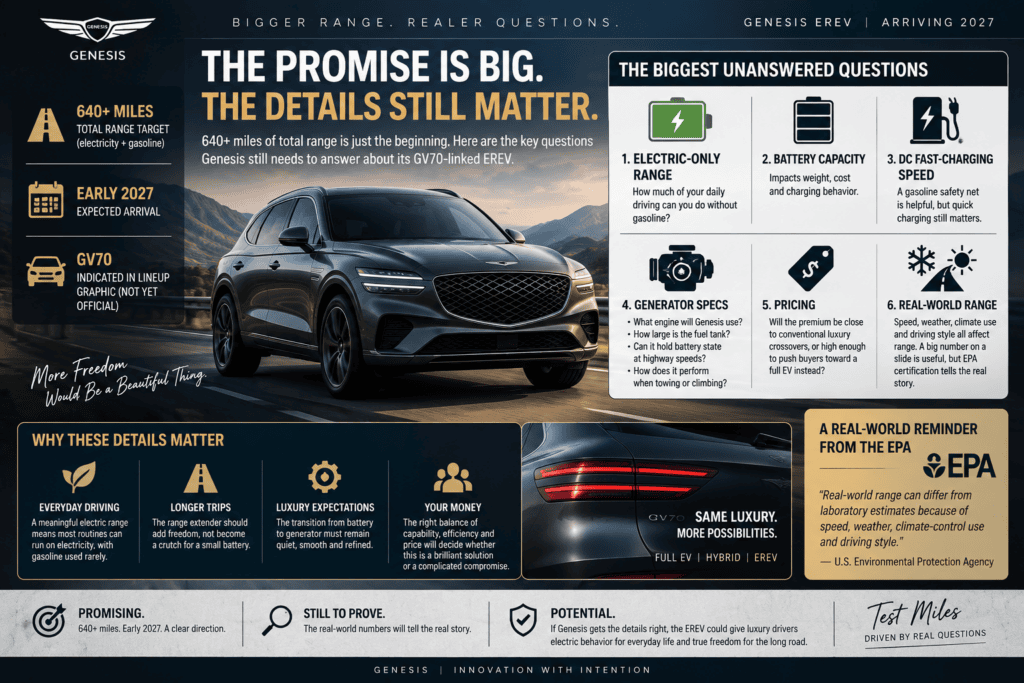
Price may be the toughest test. An EREV contains expensive electric hardware plus an engine and fuel system. If the premium over a comparable gasoline or hybrid GV70 becomes too large, buyers may decide that stopping to charge a full EV is the simpler compromise. If it can be priced near conventional luxury crossovers, the technology becomes considerably more persuasive.
The EPA also reminds consumers that real-world range can differ from laboratory estimates because of speed, weather, climate-control use and driving style. That is true for a battery EV and it will remain relevant to the electric portion of an EREV. A giant total-range number cannot repeal physics.
You may also enjoy: 2027 Genesis GV70 Adds Prestige Graphite Trim
The strongest reason to watch this vehicle is therefore not the possibility of driving 640 miles without thinking about energy. It is the possibility of making electric propulsion feel less conditional for a luxury buyer.
Genesis has an opportunity to create a vehicle that behaves like an EV during the part of ownership that matters most, everyday driving, while carrying a built-in solution for the rare journeys that make some customers reluctant to go fully electric. That is a more nuanced proposition than chasing the biggest battery possible.
But the burden is now on Genesis to show its work. The final battery-only range, EPA certification, fuel economy, charging performance, generator refinement and price will tell us whether this is a clever bridge between combustion and full electrification or simply a complicated way to print a very large range number on the brochure.