2026 Subaru Forester Review: Premium Hybrid Wins?
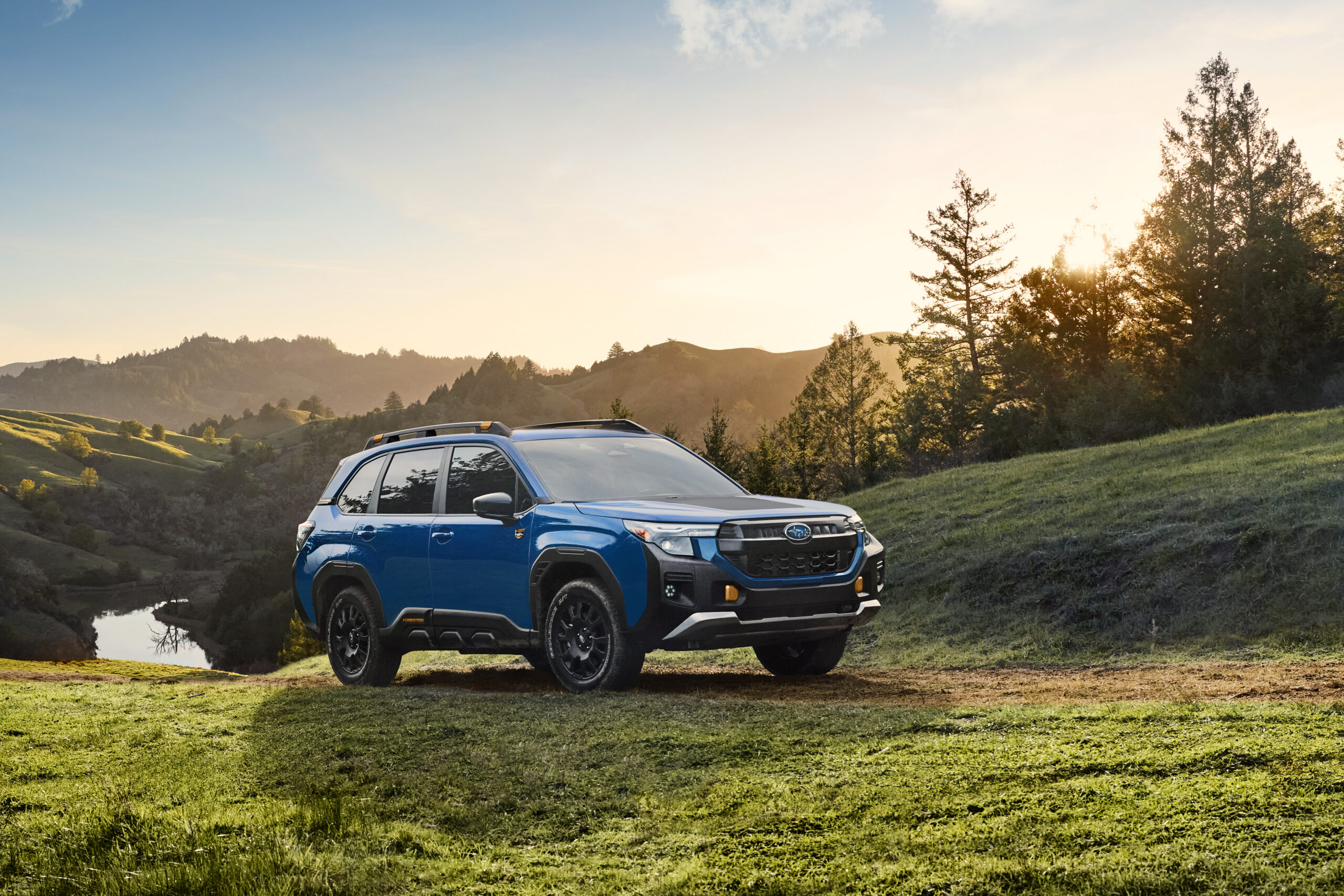
Our 2026 Subaru Forester review compares the Premium, Hybrid and Wilderness to find the smartest buy for families who want safety, space and all-wheel drive.
By Nik J. Miles
There is something rather refreshing about an SUV that knows what it is supposed to do. The Subaru Forester is not pretending to be a sports car with enormous wheels, nor is it trying to turn the school run into an expedition across the Sahara.
It is a practical five-seat SUV with standard all-wheel drive, genuinely useful ground clearance and a range of versions that now includes a fuel-saving hybrid and a more capable Wilderness.
The question is which one deserves your money.
For this 2026 Subaru Forester review, I would start by asking for prices on the Premium and Premium Hybrid. At $31,995 and $34,730 respectively, before destination and other charges, they represent two quite different approaches to the same family transportation problem.
The important limitation is that this is a specification-based vehicle analysis. No new Forester driving notes, original fuel-economy measurements or test vehicle window sticker were supplied. The recommendations below are based on documented equipment, official figures and buyer value, not an invented road test.
Best for: Families who want standard all-wheel drive, strong independently evaluated safety performance and a cabin designed around everyday usefulness.
Skip if: You need three rows of seats, regularly tow more than the Wilderness is rated to handle, or want a plug-in hybrid that can cover substantial journeys using external electricity.
You may also like this video:
2026 Subaru Forester review: What is good and what needs thought?
Pros
- Standard all-wheel drive on every version.
- IIHS Top Safety Pick+ recognition for the 2026 model.
- Hybrid efficiency of 35 mpg city and 34 mpg highway.
- Up to 8.7 inches of clearance on conventional versions, rising to 9.3 inches on Wilderness.
- Useful five-seat packaging and up to 74.4 cubic feet of cargo space in applicable configurations.
Cons
- The Hybrid requires a substantially higher initial investment than the gasoline Base or Premium.
- The Wilderness sacrifices fuel economy for additional capability.
- Base does not receive the larger 11.6-inch touchscreen fitted to Premium and higher versions.
- Maximum towing capacity on regular gasoline versions is just 1,500 pounds.
The Forester deserves consideration because its principal benefits are available without buying the most expensive trim. Subaru does not make customers climb to Touring simply to obtain all-wheel drive or its standard EyeSight assistance.
You may also enjoy: 2026 Subaru Crosstrek Vehicle Analysis: Start With Premium.
Why I would quote the Premium Hybrid first
The 2026 Forester Premium Hybrid starts at $34,730, compared with $31,995 for the gasoline Premium.
That is a $2,735 difference before delivery, taxes, equipment differences and any dealership discount.
The hybrid increases output from 180 horsepower in the conventional gasoline Forester to 194 horsepower combined. More importantly for many owners, it improves city fuel economy from 26 mpg to 35 mpg, according to Subaru’s published EPA estimates.
The Hybrid also includes a conventional gasoline engine, electric motor and battery. It does not need to be plugged in. Owners fill it with gasoline and drive it much as they would any other Forester.
This is exactly the sort of electrification that makes sense for households without convenient charging facilities. They can reduce gasoline consumption without installing equipment at home or planning stops around public chargers.
There is, of course, the matter of paying for it.
The Hybrid’s price difference cannot be justified simply by pointing to a fuel-economy sticker. It also includes equipment not necessarily fitted to the gasoline Premium. Buyers must compare both vehicles as configured.
For someone planning to keep the vehicle for many years and driving substantial annual mileage, Premium Hybrid is the first version I would investigate. For a low-mileage household concerned mainly with purchase price, gasoline Premium remains an excellent place to begin.
Subaru publishes its full range of equipment on the official 2026 Forester features page.
The trim ladder is where expensive mistakes begin
The Forester’s price structure rewards buyers who understand the difference between capability and convenience.
| 2026 Forester version | Starting MSRP | My buying consideration |
|---|---|---|
| Base | $29,995 | Lowest initial price |
| Premium | $31,995 | Gasoline value choice |
| Premium Hybrid | $34,730 | Efficiency-oriented choice |
| Sport | $34,795 | Equipment and styling preference |
| Limited | $35,995 | More comfort equipment |
| Wilderness | $36,995 | Extra trail and towing capability |
| Sport Hybrid | $37,930 | Hybrid with Sport appointments |
| Limited Hybrid | $38,995 | Hybrid plus additional amenities |
| Touring | $39,995 | Top gasoline luxury equipment |
| Touring Hybrid | $41,545 | Top hybrid luxury equipment |
These are published starting MSRPs and exclude destination, options, taxes and fees. None is a Test Miles price as tested.
A Base Forester gets you the core SUV, including the 180-horsepower engine and all-wheel drive. Premium adds a substantially more useful technology package, including the larger multimedia screen and wireless smartphone connectivity.
Sport, Limited and Touring primarily deserve attention because of particular appointments and comfort features. Do not assume a higher gasoline trim provides additional engine performance.
Touring Hybrid buyers are spending $6,815 more in starting MSRP than Premium Hybrid buyers. That is a sizeable sum to commit for equipment rather than an improvement in the basic function of the SUV.
The right process is to make a list of the equipment you genuinely need, then stop climbing the trim ladder when that list is satisfied.
How much gasoline can the Hybrid actually save?
Subaru lists the standard Forester Premium at 26 mpg city and 33 mpg highway, with the Premium Hybrid rated at 35 city and 34 highway.
There is a much bigger difference in city driving than highway driving. That distinction matters.
At a steady motorway speed, the Hybrid’s official highway advantage is modest. Stop-and-go commuting gives the electrical assistance and regenerative braking more opportunities to reduce gasoline consumption.
Subaru advertises up to 581 miles of range on a tank for the Hybrid. That is a published manufacturer figure under specified conditions, not an independently measured road-trip distance.
Fuel consumption in the real world depends on traffic, weather, terrain, tires, speed and vehicle load. This analysis includes no original Test Miles fuel economy result.
My buying advice is to calculate annual fuel costs using your own mileage and actual local fuel price. Compare those savings with the complete difference between two dealership quotations.
A hybrid might be the better long-term purchase. It does not automatically become the less expensive one.
For more on Subaru’s hybrid direction, see Subaru’s Forester and Crosstrek Hybrid plans.
Family space matters more than another touchscreen
The Forester’s upright shape gives Subaru a sensible starting point for packaging passengers and luggage.
Subaru lists passenger volume of up to 110.8 cubic feet and, in the appropriate configuration, maximum cargo space of 74.4 cubic feet with the rear seating folded. Other configurations have different cargo figures, so verify the exact vehicle.
What would I check before buying one?
First, the rear doors with a child seat in position. There is no substitute for confirming that the seat installs correctly and leaves enough room for the adult sitting in front.
Second, the cargo opening. A wide tailgate is lovely, but if the dog crate or stroller will not fit through it, a brochure’s cargo-volume measurement is not terribly reassuring.
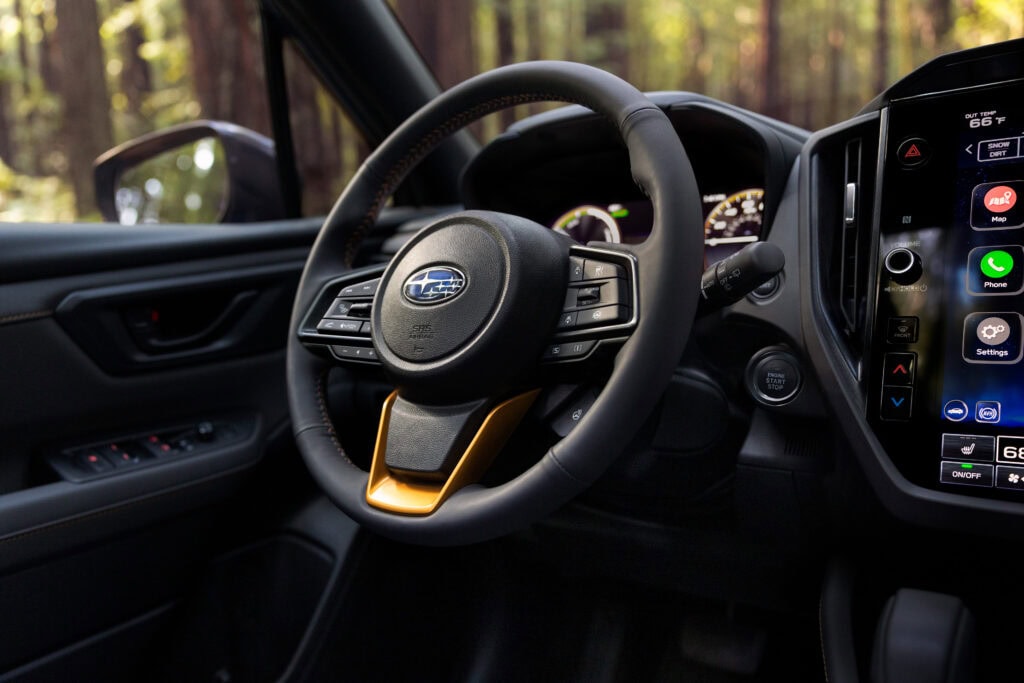
Third, the relationship between the driver, the seat and the controls. Sit in the vehicle for more than a quick demonstration. Set the seat correctly and confirm you can see the instruments and reach frequently used controls without stretching.
Some buyers will appreciate the available power rear gate. Others will be more concerned about whether muddy shoes, wet sporting equipment or a large dog can be accommodated without destroying the cabin.
For those families, consider durable upholstery, securely restrained animals, a cargo liner and fitted all-weather floor mats. Those practical purchases may have more everyday value than decorative exterior accessories.
And remember that folding a rear seat to obtain maximum cargo volume removes passenger seating. You cannot have five occupants and the entire expanded cargo area at the same time, however talented Subaru’s marketing department may be.
Wilderness should be a capability decision
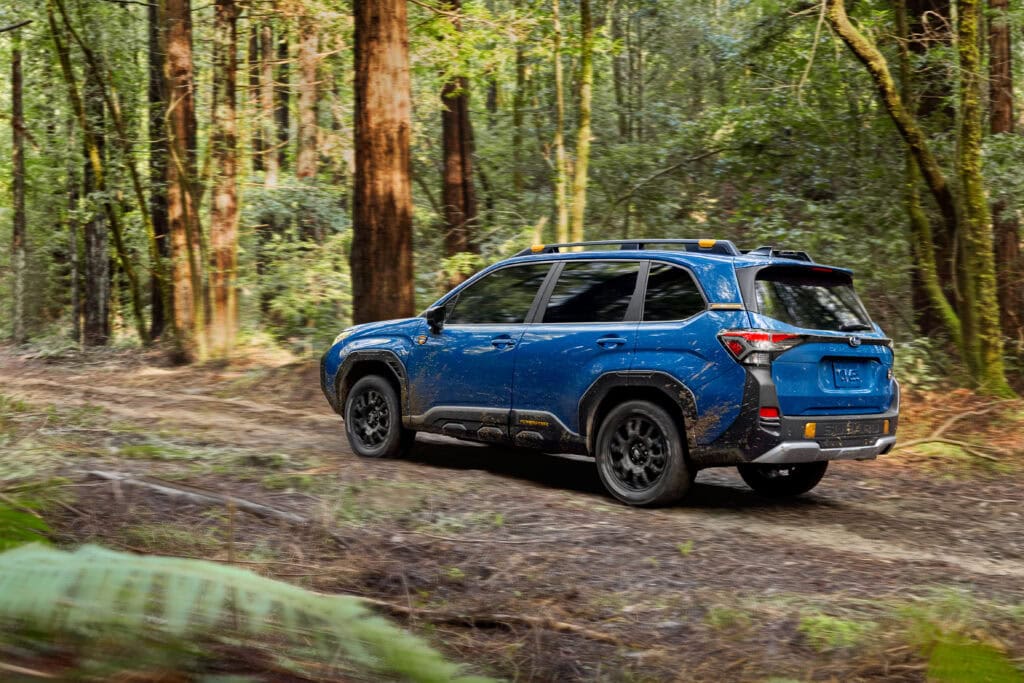
The Forester Wilderness is not simply a standard Forester wearing tougher-looking clothing.
Its 9.3 inches of ground clearance exceeds the 8.7 inches offered by conventional versions. Subaru also rates it to tow up to 3,500 pounds, compared with 1,500 pounds for the regular gasoline Forester.
Those are meaningful specifications for buyers who regularly travel on difficult unpaved roads or need to tow a suitable small trailer.
But towing capacity is a maximum under specified conditions, not a promise that every 3,500-pound trailer is appropriate. Actual vehicle loading, trailer tongue weight, equipment and the owner’s manual all matter.
The Wilderness also uses more gasoline. Subaru publishes 24 mpg city and 28 highway.
If your weekend adventures involve a gravel car park outside a coffee shop, a conventional Forester is likely to provide enough ground clearance.
If your activities involve rougher surfaces and genuine towing requirements, the extra capability becomes much easier to justify.
Neither version removes the importance of suitable tires. All-wheel drive helps deliver power to the road; it does not repeal the laws of physics when braking on ice.
The 2026 safety story is bigger than EyeSight
This is an area where the Forester deserves particular attention.
The Insurance Institute for Highway Safety awarded the 2026 Forester Top Safety Pick+.
More importantly, the institute identifies a specific 2026 change: Subaru revised the rear-seat belts to improve rear-occupant protection during its updated moderate-overlap frontal crash test.
The updated test evaluates how well the vehicle protects passengers seated in the rear, not simply the person driving.
For households frequently carrying children, that deserves more attention than an illuminated badge or a fancy new graphic on a dashboard display.
The Forester also carries standard EyeSight driver assistance, including automatic pre-collision braking and advanced adaptive cruise control with lane centering.
These systems can provide useful support, but they have operating limits and require an attentive driver. Treat them as assistance rather than autonomous driving.
When shopping, also verify the exact trim’s blind-spot detection, parking assistance and camera equipment. The fact that a feature is available somewhere in the range does not mean it is fitted to the vehicle sitting on the dealership lot.
The alternatives: RAV4, CR-V and Tucson
Before signing for a Forester, I would also investigate the Toyota RAV4, Honda CR-V and Hyundai Tucson.
The RAV4 is a natural alternative for shoppers placing particular emphasis on hybrid powertrains. Compare current-model equipment, prices and official fuel-economy figures rather than relying on an older model-year review.
The Honda CR-V deserves attention from families who want to compare rear-seat packaging, cargo arrangements and interior usability. Put the same child seats and luggage in both vehicles.
The Hyundai Tucson offers another distinct combination of technology, interior design and available hybrid configurations.
The Subaru’s argument is straightforward. Every Forester has all-wheel drive, and buyers can select between conventional gasoline power, hybrid efficiency and Wilderness capability.
The competition may offer better value for individual buyers depending on drivetrain, features and the final transaction price.
Compare vehicles as equipped. A competitor’s cheaper front-wheel-drive version is not necessarily equivalent to an all-wheel-drive Forester.
You may also enjoy: 2026 Subaru WRX Review: Start With the Premium, another look at buying useful Subaru equipment without paying unnecessarily for higher trims.
My verdict: Start with Premium, then price Hybrid
The 2026 Forester is a useful reminder that buying an SUV should be a practical exercise rather than a competition to obtain the largest window sticker.
For a household with modest annual mileage, the gasoline Premium is where I would start. It provides the core Forester strengths and more useful everyday technology than Base without a dramatic increase in initial price.
For a family covering substantial mileage, particularly in urban and suburban conditions, I would take the Premium Hybrid seriously. Its 35-mpg city rating and 194-horsepower hybrid system provide meaningful differences from the conventional gasoline model.
Wilderness makes sense when towing and trail capability are regular requirements. Touring Hybrid is for buyers who genuinely want its additional comfort appointments and are happy with the price.
My preferred starting point is the Premium Hybrid, but only after comparing its complete transaction price with the gasoline Premium. An SUV that saves fuel but stretches the household budget beyond comfort is not a clever purchase.
Buy the capability you need. Buy the comfort you will use. Leave the rest of the equipment list for somebody else.
2026 Subaru Forester frequently asked questions
Is the 2026 Subaru Forester a new design?
The standard Forester was redesigned for the 2025 model year. The 2026 range builds on that vehicle, including updated rear-seat belt protection documented by IIHS and a Wilderness model with greater off-road and towing capability. Buyers should distinguish those changes from the earlier introduction of the current body design.
Does the 2026 Forester Hybrid need charging?
No. The Forester Hybrid uses a gasoline engine and an electrically assisted hybrid system that manages its own battery. You do not need a home charger or a public charging station. It is designed to deliver improved gasoline economy without the ownership requirements of a plug-in hybrid or fully electric vehicle.
Which 2026 Forester trim is the best value?
The gasoline Premium is my starting point for a budget-conscious buyer because it adds useful features to the standard all-wheel-drive package. The Premium Hybrid is worth investigating for drivers whose mileage and usage patterns make improved fuel economy attractive. The better choice depends on your actual purchase price and driving habits.
How much can a 2026 Subaru Forester tow?
Subaru rates the regular gasoline Forester at up to 1,500 pounds, while the Wilderness is rated at up to 3,500 pounds. Verify the exact configuration, trailer equipment, vehicle payload and tongue-weight requirements before towing. A manufacturer’s maximum tow rating is not a substitute for checking the complete loaded combination.
Is the 2026 Subaru Forester safe?
IIHS gives the 2026 Forester its Top Safety Pick+ award. The institute documents an improvement in rear-passenger protection following seat-belt changes for the model year. Standard EyeSight driver assistance also includes collision-mitigation features. No vehicle can eliminate crash risk, and drivers must remain attentive even when assistance systems are operating.
Should I buy a Forester or a Crosstrek?
The Forester is the more logical starting point for buyers who need greater family and cargo accommodation. The smaller Crosstrek deserves consideration if purchase price, exterior dimensions and easier parking are higher priorities. Try both with your regular passengers and luggage. Both offer all-wheel drive and hybrid choices, but their packaging and prices differ.