Jeep Grand Cherokee Recall Hits 328,381 SUVs Again
By Robert R Guio
The Jeep Grand Cherokee recall now covers 328,381 SUVs, with a new isolator replacement and fresh guidance for owners of affected Jeeps.
The number 328,381 is the attention-grabber. The more important part of this Jeep recall is the word again.
FCA US has told the National Highway Traffic Safety Administration that certain fifth-generation Jeep Grand Cherokee, Grand Cherokee L and Grand Cherokee 4xe models may have a rear coil spring installed out of position. In the worst case, that spring can detach while the SUV is moving. NHTSA campaign 26V562, which Jeep identifies internally as 89D, is now the latest attempt to resolve a condition that has already produced two earlier federal recall campaigns.
That history changes how an owner should read the notice. Someone who completed an older rear-spring recall could reasonably assume the issue was finished. It is not. The new federal acknowledgment says vehicles repaired under recalls 23V413 and 26V051 still need the latest remedy.
Why the Jeep Grand Cherokee recall is different this time
This campaign did not begin with a completely new defect appearing on an unrelated vehicle. It grew out of evidence that the earlier repair strategy was not consistently closing the problem.
FCA US first made a safety-defect determination on the rear-spring condition in June 2023. In September 2025, NHTSA sent the company a pre-investigation request after the agency identified 20 complaints describing coil-spring separation after the 2023 recall repair had been performed. FCA US responded with internal data that flagged another 70 records as potentially related to the same condition.
The manufacturer opened a technical investigation in November 2025. By January 2026, it had made another safety determination and launched campaign 26V051 for 80,620 SUVs across the two-row Grand Cherokee and three-row Grand Cherokee L lines. That action relied on inspection of the rear coil-spring assemblies with repair as necessary.
Then the problem returned to the regulator’s attention. FCA US says NHTSA sent additional vehicle-owner complaints during July 2026 and met with the company. On July 24, FCA launched another investigation, this time focused on spring separations reported after work under the 2023 and early-2026 campaigns. Its Vehicle Regulations Committee made another safety-defect determination Aug. 26, and the new Part 573 report was submitted Sept. 1.
Readers who want the underlying federal process rather than a summary can review NHTSA’s investigation and recall resources. The current campaign itself is documented in FCA US’s Part 573 safety recall report filed with NHTSA.
You may also enjoy: Recall Roundup: Jeep, Honda, Lucid Owners Warned
328,381 vehicles, but a 0.1% defect estimate
The recall population is large, but it should not be read as 328,381 confirmed defective Jeeps. The manufacturer’s filing puts the estimated defective share of the campaign population at 0.1%. That is a manufacturer estimate submitted in the federal filing, not a guarantee about any one SUV.
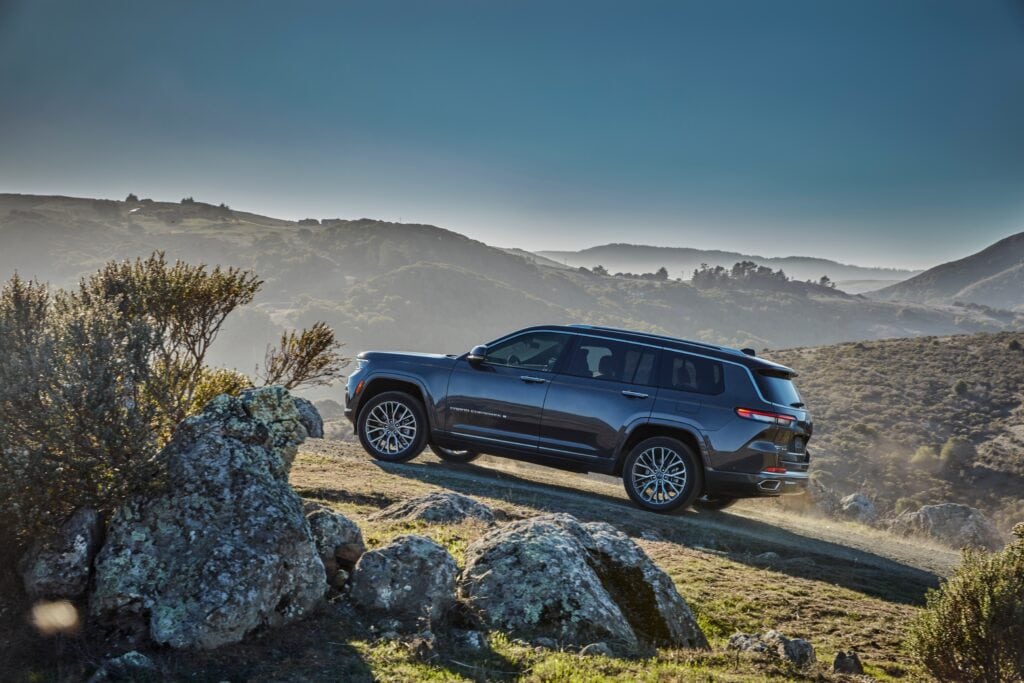
The population breaks down unevenly. The Grand Cherokee L is by far the largest group: 215,433 potentially involved 2021-2023 vehicles, with production dates running Dec. 5, 2020, to May 31, 2023. For the two-row Grand Cherokee, FCA lists 97,477 potentially involved 2022-2023 models and a production window of May 17, 2021, to May 31, 2023. The plug-in-hybrid group contains 15,471 2022-2023 Grand Cherokee 4xe models; its listed production window runs Aug. 4, 2021, to May 31, 2023.
There is another useful boundary in the filing: comparable vehicles using an air-suspension system are excluded. That is one more reason not to decide recall status from a broad model-year list. Two Jeeps parked side by side can wear the same model badge and still have different campaign status.
By Aug. 6, FCA US had tagged 29 customer-assistance records plus 406 warranty claims across all markets as potentially connected with the condition. It reported no accidents or injuries potentially related to the condition as of the same date. Those warranty figures should not be divided mechanically into the U.S. population to produce a failure rate. The filing describes the records as potentially related and says they span all markets; they are not a count of 406 confirmed defective U.S. vehicles.
The safety consequence, however, is not trivial simply because the estimated defect percentage is small. FCA’s risk description says a separated spring can create a hazard for other road users, with a crash possible before the driver receives any meaningful warning. There is currently no “Do Not Drive” or “Park Outside” advisory attached to the campaign, so the sensible response is prompt verification and repair rather than panic.
You may also enjoy: 11.6 Million Vehicles Recalled in 2026 What You Must Know
The repair is more prescriptive now
The most useful difference for owners is what dealers are being told to do. The new campaign calls for replacement of both rear coil-spring lower isolators at no charge. FCA US tells NHTSA that the campaign is not about a defective isolator component itself; the company describes the underlying problem as an assembly or repair condition in which the rear coil-spring assembly may be out of position.
That is materially different from telling an owner that a previously installed part has suddenly been discovered to be weak. The issue is positioning. The lower isolator sits at the spring’s mounting interface and helps locate the assembly while isolating contact and vibration. The latest remedy is intended to give every affected vehicle a defined replacement procedure rather than leaving the campaign centered on whether inspection finds a condition that needs correction.
For an owner who already visited a dealer once, that distinction may be frustrating. It is also exactly why the superseding campaign matters. A completed work order from 2023 or early 2026 documents that the owner did what was asked at the time; it does not prove campaign 89D has been completed.
Interim owner notices are planned to begin around Sept. 29, with the Part 573 filing giving an interim-mailing window through Oct. 7. A later notification will follow when the final remedy is available. Dealer notification is planned around Sept. 9, the same date the campaign’s affected VINs are scheduled to become searchable.
You may also enjoy: The 2026 Jeep Grand Cherokee Simplifies on Purpose
The VIN matters more than the badge
Here is the practical Test Miles advice: do not use the model-year list as the final answer. Use the VIN.
NHTSA’s official recall lookup allows owners to check a vehicle by its 17-character identification number. For this campaign, the federal filing says the relevant VINs are scheduled to be searchable beginning Sept. 9, 2026. If you check before that date and see nothing, check again after the campaign population is loaded.
If 89D appears as an open recall, call an authorized Jeep dealer and ask two questions: whether the final remedy is available for your VIN, and when the dealer can perform it. Because the initial owner letter is an interim notification, the answer on parts availability may not be immediate everywhere. FCA US customer service is listed as 800-853-1403 in the federal acknowledgment.
Owners who like automatic reminders can also use NHTSA’s SaferCar app, which is designed to notify users about safety recalls for saved vehicles and equipment. If there is uncertainty about a federal campaign, NHTSA publishes its Vehicle Safety Hotline and contact information as well.
Used-SUV buyers should be even more deliberate. A seller may show you an invoice proving that an earlier coil-spring recall was performed. For these affected Jeeps, that is not enough. Run the VIN yourself, check whether 89D is open, and ask for documentation of the new remedy once it becomes available. A current federal VIN status is more useful than an old service receipt when a recall has been superseded.
The same advice applies to shoppers comparing a gasoline Grand Cherokee with a 4xe. The powertrain is not the deciding factor for this suspension campaign; certain examples of both are included. The air-suspension exclusion and precise build ranges make VIN-level verification the cleanest path.
You may also enjoy: The 2026 Jeep Grand Cherokee: Evolution or Revolution?
What this says about recall trust
There is a temptation to judge a recall by its headline number. That is rarely the best measurement. The more revealing question is whether the defect is well defined, whether owners can identify affected vehicles, and whether the remedy actually closes the failure mode.
This campaign is uncomfortable for Jeep because the chronology documents complaints after earlier recall repairs. For customers, a repeat trip to the dealer is real inconvenience, and confidence is not strengthened when a repair that was supposed to finish a safety issue is later superseded. That deserves to be said plainly.
It is also worth recognizing what the recall system is doing. Complaints were collected, NHTSA challenged the earlier outcome, FCA US reopened its investigation, and the remedy changed. The public can examine campaign data, chronology and recall records through NHTSA; researchers can also access the agency’s vehicle-safety datasets and APIs. A repeat recall is evidence that the first solution did not prove sufficient, but the second investigation is also evidence that the process did not simply stop when the first repair closed on paper.
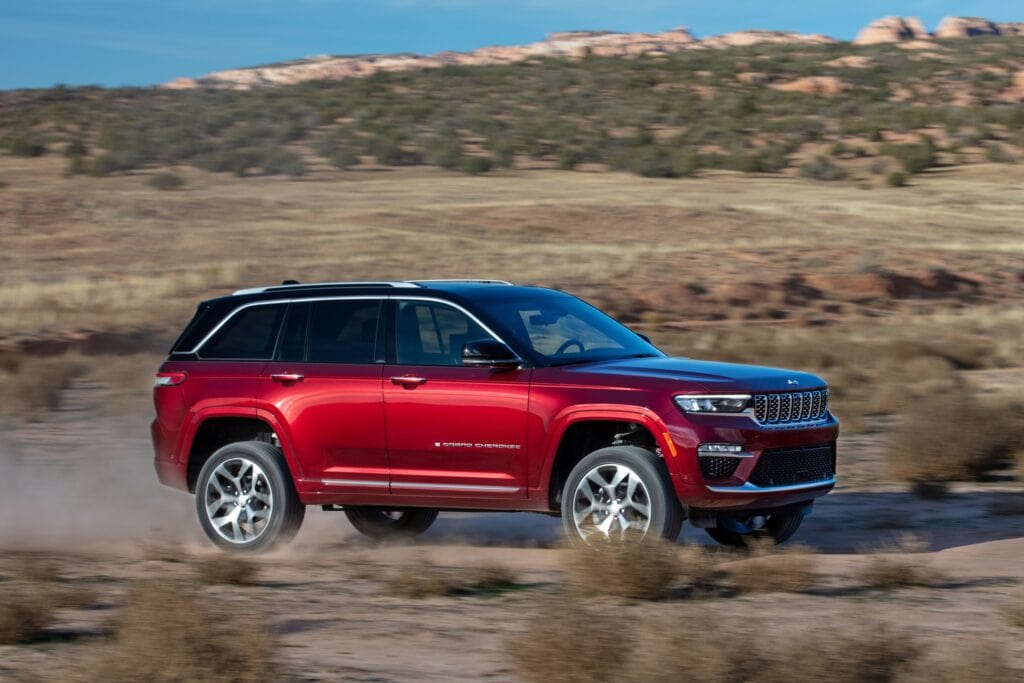
For Jeep, this lands at a sensitive time. The Grand Cherokee remains one of the brand’s most important family SUVs, while newer versions are being repositioned around simpler trims, updated powertrains and a clearer value story. Owners do not separate those product promises from the service experience. A recall handled quickly and transparently can become maintenance history; a recall that needs repeated correction can become a trust problem.
That does not mean owners should conclude their Grand Cherokee is unsafe merely because it falls within a listed model year. FCA US estimates only a small share of the 328,381-vehicle campaign population actually contains the defect, and it reported no related accidents or injuries as of Aug. 6. It does mean the latest campaign deserves attention precisely because earlier repair status no longer settles the question.
You may also enjoy: The Jeep Reset: How the Brand Is Rebuilding to Survive
The smartest response is administrative rather than dramatic: verify the VIN, save the campaign number 89D, keep every service document, and complete the lower-isolator replacement when your vehicle is eligible. If you are buying one of these Jeeps used, make the recall check part of the deal before money changes hands.
For this Jeep Grand Cherokee recall, 328,381 is the number that gets the headline. The better consumer number is one: your VIN. That single identifier tells you whether this latest repair belongs on your to-do list.