F1’s Other World Championship: Drivers and The World Cup
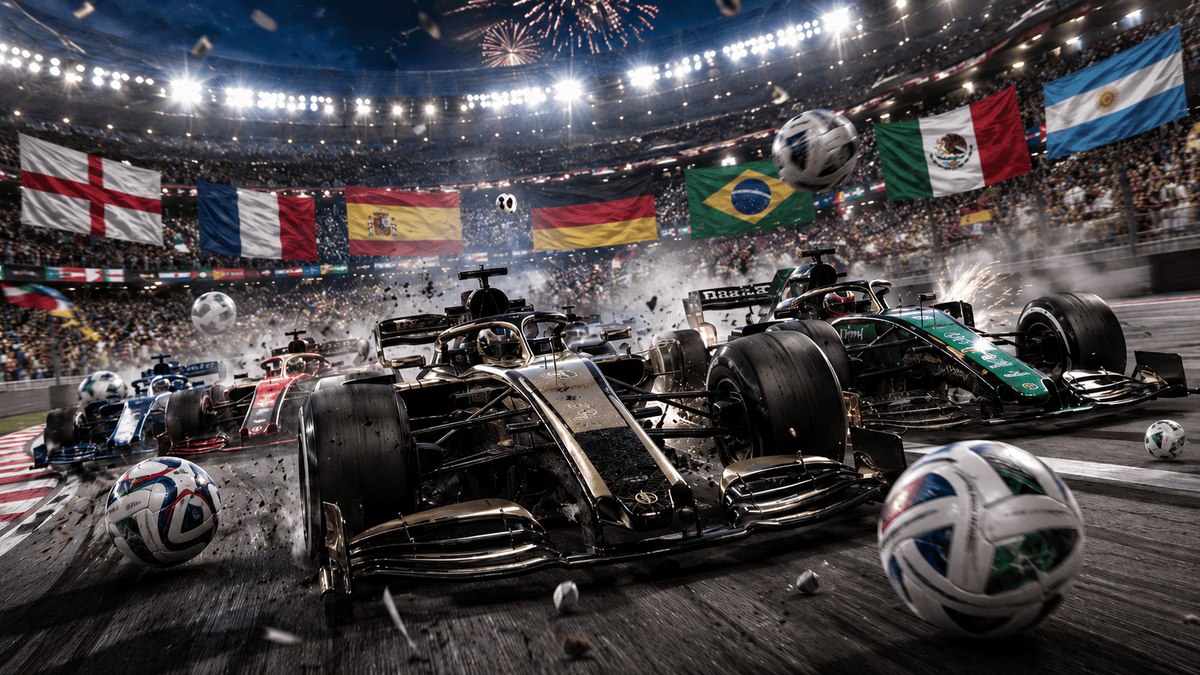
Formula 1 likes to present itself as a sport of teams. Drivers wear the colors of Mercedes, Ferrari, McLaren, Red Bull, Alpine, Aston Martin, Haas, Williams and more, then spend most weekends talking about race pace, tire life and what the garage needs to improve.
Then the World Cup arrives, and all of that becomes less important for a few hours.
That is the fun angle. When football takes over the world, F1’s corporate geography gets pushed aside. A driver may race for a German, Italian, British or American-linked team, but when the anthem starts, the factory badge usually loses to the birth flag, the childhood flag or the flag that feels like home.
You may also like: Mercedes-AMG’s GT 63 “APXGP Edition” Puts Hollywood in the Fast Lane — But Is It More Than a Movie Car?
England Has The Biggest F1 World Cup Crowd
If this were a paddock watch party, England would probably need the biggest table. George Russell, Lewis Hamilton, Lando Norris, Oliver Bearman and Kimi Antonelli all land in the England camp on this fan map, giving England the kind of numbers most nations would envy.

That group also gives the story its richest contrast. Hamilton wears Ferrari red now, but that does not make Italy his football team. Russell races for Mercedes, but England is still the emotional center. Norris has become one of the faces of McLaren, yet the pull of England during a World Cup is different from the pull of a team factory.
Bearman adds the next-generation angle, the young British driver who would grow up with England’s modern football expectations baked into the background. Antonelli is the wrinkle, because F1 allegiances are never as tidy as a garage wall. In Formula 1, a driver’s working life may be multinational. On the current F1 grid, those national flags sit right next to the team names. In the World Cup, the heart usually chooses one flag.
You may also like: Rúben Dias and the Lamborghini Revuelto: Where Football Meets Ferocity
France And Spain Bring A Proper Rivalry
France has its own strong F1 football section with Esteban Ocon, Isack Hadjar and Pierre Gasly. That is a serious trio, and it gives the French side a natural paddock identity. Ocon’s calm competitiveness, Gasly’s intensity and Hadjar’s rising-star energy would all fit a French team that expects deep tournament runs, not pleasant participation.

Spain has a smaller but persuasive group. Carlos Sainz and Fernando Alonso represent different generations of Spanish racing confidence. Sainz brings the modern, measured, tactical approach. Alonso brings the old-school refusal to go quietly, which is exactly the sort of personality every FIFA World Cup fan recognizes.
That comparison is where the story gets entertaining. In F1 terms, the drivers may share circuits, press rooms and awkward cooldown rooms. In football terms, there is no neutral ground. Once the World Cup begins, team hospitality stops at the door. France is France. Spain is Spain.
You may also like: Why Indy 500 Fans Still Say Carb Day
The Solo Flags May Be The Loudest
Some drivers get to carry a nation almost by themselves in this version of the World Cup paddock. Oscar Piastri is the Australian standard-bearer, cool, dry and quietly ruthless. Max Verstappen is, naturally, the Netherlands. He already races with a sea of orange behind him, so a Dutch World Cup run would feel like an extension of the grandstand he brings everywhere.
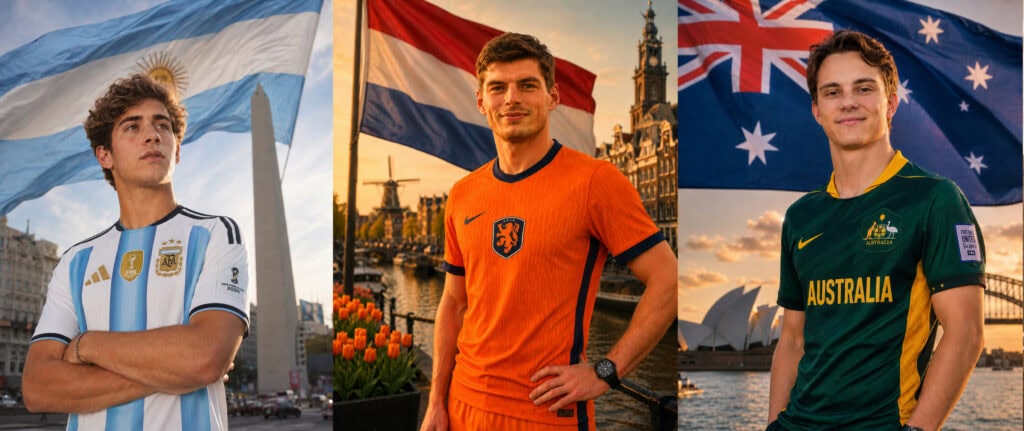
Franco Colapinto gives Argentina the football romance. Argentina is never just another World Cup team, and for an Argentine F1 driver, that shirt carries history, pressure and joy. Liam Lawson does the same for New Zealand, a smaller football nation but a fiercely proud one.
Then come the national singletons with big personalities attached. Nico Rosberg gives Germany a former champion’s view of expectation, and his official Formula 1 Hall of Fame profile is a reminder of how much a national racing identity can last beyond the cockpit. Gabriel Bortoleto gives Brazil a young driver’s connection to a country where football is not a pastime, it is cultural weather. Lance Stroll carries Canada, one of the host nations, while Sergio Perez carries Mexico, another host nation, and probably the loudest emotional link of them all.

That is the charm of this crossover. F1 is about precision, data and loyalty to the team. The World Cup is about memory, noise and loyalty to the flag. For a few weeks, the driver suits matter less. The passport, the anthem and the colors in the crowd matter more. It may be the one race where every Formula 1 driver is happy to be just another nervous fan.